Outside Looking In - a vendor perspective on event production for internal production teams
In Spring 2023, I had the opportunity to present at the University of California Video Producers Conference. This annual event brings together video and production professionals from all over the University of California System to share resources, reconnect with colleagues, and inspire each other with new ideas. As a founding member of this group, I was asked to come back as a featured guest speaker and present to an audience of my former colleagues with an outside perspective on the work we share.
Podcasts about Accessibility
I recently had the opportunity to speak on two different podcasts about a subject I’m very passionate about - Event Accessibility. The conversations are a bit different -
On the first, with Alana Mediavilla of FilmKik, I speak more generally about the role and importance of accessibility, and the ways video producers can ensure their content is accessible to all
On the second, Ben Powell of BetterCast and I get into the nitty gritty of different caption systems and how they work. Fair warning, this one is long and has a lot of tech detail.
The AV IT Convergence and Live Event IT
My friend Tim Kay and I were on the AV Nation Podcast “The IT Factor” this week, discussing the confluence of AV and IT with regard to live events.
Episode 49 of the AV Nation podcast IT Factor, featuring Tim Kerbavaz and Tim Kay
Advice for Independent AV Technicians - Sound Design Live Interview
I was recently a guest on the Nathan Lively’s podcast Sound Design Live discussing ways that independent AV technicians can adapt in the face of Covid-19. It’s designed for AV industry professionals, but it’s got some general advice that might be useful to other folks in the event space. This video also has some background on me, which clients may find interesting.
I was recently a guest on the Nathan Lively’s podcast Sound Design Live discussing ways that independent AV technicians can adapt in the face of Covid-19. It’s designed for AV industry professionals, but it’s got some general advice that might be useful to other folks in the event space. This video also has some background on me, which clients may find interesting.
A Music Festival, in this Pandemic?! How Mutek.SF shook up the virtual event scene
Mutek is an internationally renowned electronic music and digital arts organization that hosts annual festivals in cities globally. The relatively new Mutek San Francisco chapter was faced with a challenge for their 3rd annual festival in May 2020: In the face of Covid-19 should they cancel, or find a way to translate an engaging, creative community festival to a virtual event.
Mutek San Francisco hosted Nexus, their 2020 online music festival, using a bespoke virtual community event platform custom built by Currents.fm for the event. Nexus combined live video streams, video-on-demand, a gallery of online Open GL artwork, live workshops on a variety of creative topics, and community-submitted art, music, and live video streams from the SF Bay Area and all over the world.

Conceptual Signal Flow Drawing for Mutek Nexus 2020
Mutek is an internationally renowned electronic music and digital arts organization that hosts annual festivals in cities globally. The relatively new Mutek San Francisco chapter was faced with a challenge for their 3rd annual festival in May 2020: In the face of Covid-19 should they cancel, or find a way to translate an engaging, creative community festival to a virtual event?
Mutek San Francisco hosted Nexus, their 2020 online music festival, using a bespoke virtual community event platform custom built by Currents.fm for the event. Nexus combined live video streams, video-on-demand, a gallery of online Open GL artwork, live workshops on a variety of creative topics, and community-submitted art, music, and live video streams from the SF Bay Area and all over the world.
Making the event community-focused and highlighting community contributions was key to the experience. In addition to the curated musical performances, live DJ sets, and film screenings, the festival highlighted live trainings and performances from both Bay-Area and global artists, as well as links to other concurrent festivals. The live audience interacted with each other and the artists via text and video chat built into the interface alongside the artwork and performances.

The Currents.FM Live Event Interface
In addition to the task of building a custom audience-facing platform, this event posed multiple content-delivery challenges. With multiple live “rooms” running simultaneously with a mix of live and pre-recorded content from many different locations, there were many sources of content going to several different destinations. There were questions of streaming infrastructure, of video endpoints at both the artist (contributor) and audience delivery endpoints of the signal flow, as well as questions of routing in between. This project required both technology solutions and the team to develop and implement them.
Mutek SF Technical Director John Mitchell brought in streaming engineers Drew Patterson of Fresh AV and myself, Tim Kerbavaz of Talon AV to provide live streaming and virtual event management expertise. Drew provided early-process technical management, and Jessie McDaniel, also of Fresh AV, provided show-day artist and stage management, coordinating live remote performances and asset collection.
As a team, we implemented a mix of technologies to make 4 concurrent live rooms possible. Two of the rooms were a mix of live content from artists’ homes and playout of pre recorded performances submitted in advance. Another room was a film screening room playing a timed schedule of films, and the fourth was a workshop room with live presentations by contributing artists.
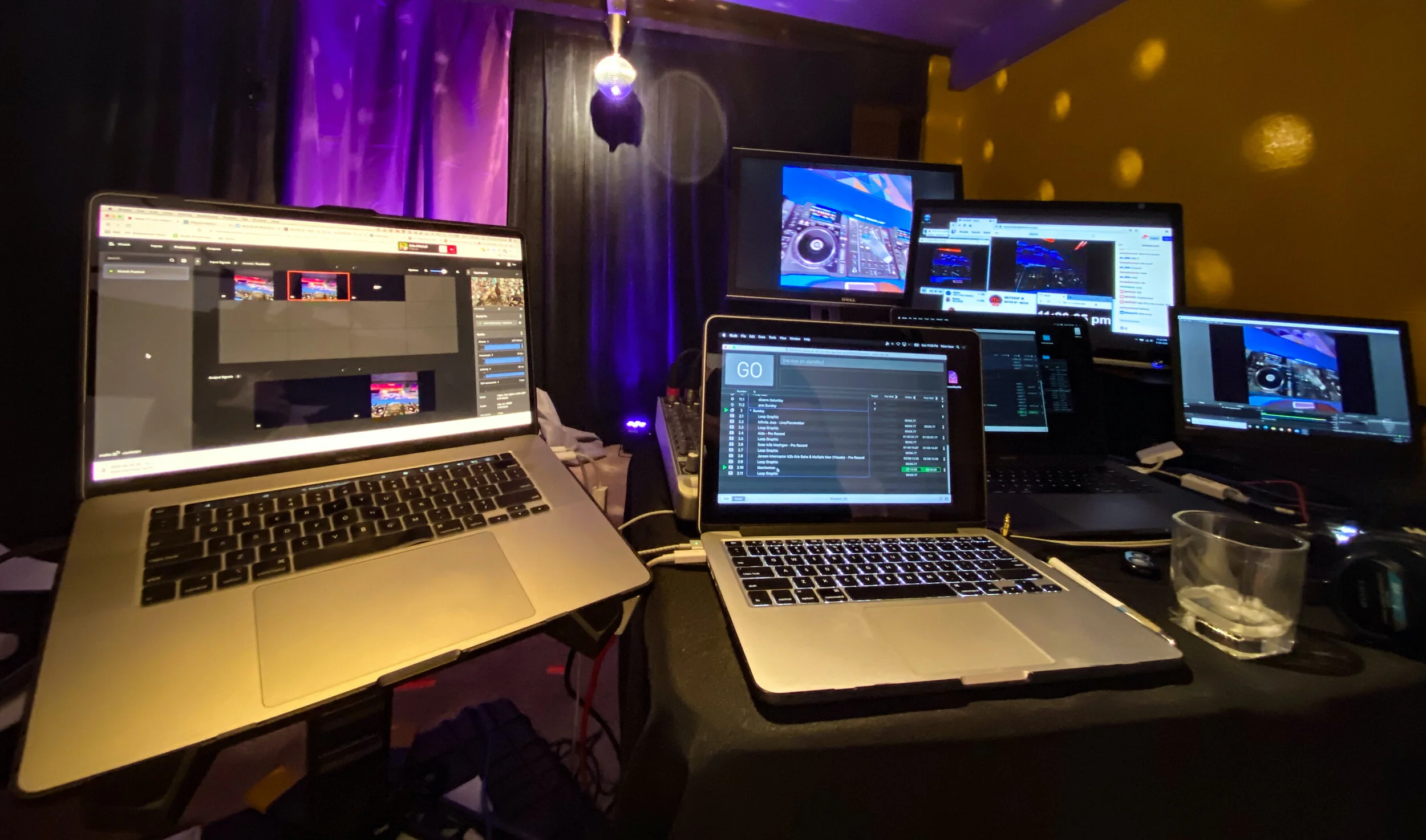
Leveraging our live event and online video expertise, Drew and I spun up playback systems in redundant locations, with playback locations in both Texas and California, as well as cloud-based playback and routing.
We used LTN Live Video Cloud, which is a cloud-based video routing system to manage, route, and record live contributions. For timed playback of pre-recorded content, we used LTN/Make.TV Playout, a cloud-based broadcast playout application, and Figure53 QLab, a desktop cue-based playback system for Mac OS. Endpoint destination streams went to Vimeo Live, Twitch, Facebook, and Youtube.

Author Tim Kerbavaz in the Sacramento Control Room for the Mutek Nexus Festival
These infrastructure choices proved to be essential to the success of the event. QLab’s Wall-Clock triggers and time-based loop cues in LTN Playout made scheduling playback based on time of day an easy feat, and the cloud routing and playback solutions from LTN enabled remote performers from all over the world to each have their own RTMP or WebRTC ingest credentials and for a team of technicians and production staff spread across two states and 3 metro areas to collaboratively manage the same production.
This was a great opportunity to try some new tools and be a part of a one-of-a-kind live music experience. The event pushed the envelope of online events, creating a new model of what a virtual event can look like and letting us stretch to the cutting edge of both video streaming and event platform technology. I look forward to applying these skills and technologies to future projects.
Tim Kerbavaz is the Technical Director of Talon Entertainment Audio Visual.
Talon Entertainment Audio Visual provides event AV production services for private, corporate, and community events across the United States. Serving a wide range of events, from political round-tables, to Silicon Valley Tech Company Conferences, to community festivals, to automotive-industry board meetings, Talon AV provides expertise and an exemplary attendee experience.
Not Quite Live Stream: A Virtual Event Video Playback Solution
I got a call this week from a client asking “how do we do an event that looks like a live stream, but is actually pre-recorded?”
Lots of the virtual events I’ve been working on have had pre-recorded sessions, if not been fully pre recorded, so I thought I’d share how I’ve been handling playback for Zoom calls or Live Streams.

Signal Flow Diagram of a typical virtual event playback solution
I got a call this week from a client asking “How do we do an event that looks like a live stream, but is actually pre-recorded?”
Lots of the virtual events I’ve been working on have had pre-recorded sessions, if not been fully pre recorded, so I thought I’d share how I’ve been handling playback for Zoom calls or Live Streams. For my higher profile events I use an ATEM Mini as an A/B switch for my redundant playback machines as well as for USB capture, but you could easily use a single playback machine and a capture card like a Magewell, a U-Tap or an UltraStudio to ingest the HDMI input into your streaming computer, and/or go directly into an encoder like a Teradek Cube to go live to stream.
Using Figure53 qLab for playback, I set “wall clock” triggers to play certain files at certain times based on the time-of-day, and then once it’s set, it’s easy to manage multiple breakout rooms at once with minimal manual input.
Reach out if you need help putting together a live event broadcast system (or if you’d like Talon to turnkey your production). Happy to provide a consult, additional assistance, or a full-service production.
Tim Kerbavaz is the Technical Director of Talon Entertainment Audio Visual.
Talon Entertainment Audio Visual provides event AV production services for private, corporate, and community events across the United States. Serving a wide range of events, from political round-tables, to Silicon Valley Tech Company Conferences, to community festivals, to automotive-industry board meetings, Talon AV provides expertise and an exemplary attendee experience.