
CART vs. AI Captioning for Live Events: How to Choose the Right One
If you're planning a live event and someone has asked for captions, you've probably run into two options that sound interchangeable but aren't. There's human CART captioning, and there's AI captioning. Plenty of articles online will tell you one of them is always better. The real answer is that it depends on your event, and choosing well can save you money on some sessions while saving you from a very public headache on others.
We provide both at Talon AV. Here's how we actually help clients decide.
What the two options really are
CART stands for Communication Access Realtime Translation. A trained, certified human captioner, either a stenographer or a voice writer, listens to your event and produces verbatim captions in real time, often at hundreds of words per minute. Stenography is a skilled profession, and a good captioner does more than transcribe sound. They handle context, jargon, crosstalk, and accents the way a human listener does.
AI captioning uses Automatic Speech Recognition, or ASR. It's the same family of technology behind your phone's dictation. Captions appear automatically from the audio, with no human in the loop. In some platforms it's quite literally a switch you flip on.
Both are useful. They just have different strengths.
The honest tradeoffs
Accuracy. This is where the real difference lives. A skilled CART captioner reliably delivers very high accuracy, even when the room is noisy, speakers overlap, or the content is full of technical, medical, or legal terminology. ASR has come a long way, but it still struggles with exactly those conditions: heavy jargon, strong accents, multiple speakers, bad audio. For a casual internal meeting, that's fine. For a keynote in front of a thousand people, a caption feed full of errors becomes its own kind of failure.
Cost. ASR is meaningfully cheaper, and for high-volume situations, like a dozen simultaneous breakout rooms over several days, the math often favors it. CART captioners are skilled professionals, and their time is priced that way. Where people get into trouble is treating cost as the only number that matters. The better question is what an inaccurate caption actually costs you on a given session.
Preparation. Both get better with prep, and this is where a lot of caption projects succeed or fall apart. Human captioners do their best work when they get speaker names, agendas, and industry terminology ahead of time, and they do even better when they can sit in on a rehearsal to get used to the speakers' cadence and accents. ASR systems can be tuned too. You can pre-load key terms and names to improve recognition. Either way, good captions are not a flip-the-switch-day-of accommodation.
Risk and the room. ASR runs on the audio it's given. Bad audio means bad captions, full stop. A human captioner can adapt mid-sentence to a surprise speaker change or an audience Q&A. A machine can't anticipate. On a high-stakes event, that adaptability is a big part of what you're paying for.
A simple way to decide
Match the method to the stakes of each session.
Human CART is usually the right call for high-profile, public-facing, or executive sessions like a keynote, a commencement, or a board meeting. It's also the right call when the content is dense with specialized terminology, when you have a formal accommodation request or a compliance requirement, or when multiple speakers and live Q&A make the audio unpredictable.
AI captioning is a reasonable fit for internal, informal, or low-stakes sessions. It works for high-volume content, like many breakout rooms over many days, where putting a human captioner in every room isn't realistic. And it makes sense when budget is genuinely the binding constraint and some captions are far better than none.
Here's the part most of the "always pick a human" articles leave out. You don't have to choose one for the whole event. You can put a human CART captioner on the general session and your highest-stakes content, and run well-prepared ASR across the breakouts. That's exactly what we did for Children's Miracle Network's Hospital Week: human CART in the general session, including the live musical performance, ASR support across the breakouts, and a full accessibility review afterward. The client got the accuracy where it mattered most and sensible economics everywhere else.
Getting captions onto the screen is its own job
One thing worth flagging, because it catches people off guard. Picking CART or ASR is only half the work. Getting those captions to show up accurately and in sync, on the in-room screens and on your live stream, takes dedicated systems and technical expertise. Broadcast-standard closed captions, CEA-608 and 708, in-room caption displays, captions burned into a stream, captions on a second-screen link, those are all different technical paths. The captioning method is the what. The caption delivery system is the how. A great captioner feeding into a broken display doesn't help anyone.
How we help
At Talon AV, we treat captioning as a production value, not an afterthought. We'll tell you honestly which method fits each part of your event, help you collect and organize prep materials for your captioning team, design the caption display and delivery systems for both in-room and streamed audiences, and build in the redundancy that keeps captions running when something goes sideways. We do this for our own clients, and as a specialty partner for other production and AV companies.
If you're weighing captions for an upcoming event, or you just want a second opinion on what your event actually needs, reach out for a consultation. And if you want the deeper technical picture, our Event Accessibility services page gets into CART, ASR, sign language interpretation, audio description, and assistive listening.
Secure Networking, Cell Bonded WiFi & Precision Turnkey AV Production for a Corporate Managers Meeting in Los Angeles
When the senior leadership of a nationwide electrical contractor gathers to define the future, the technology supporting them must be as reliable as the infrastructure they build.
In January 2026, Talon Audio Visual partnered with Austin-based agency Premier Event Source to execute this client’s Leadership Summit in Los Angeles. CA. Bringing together 160 senior leaders from across the country, this high-profile event required a flawless blend of immersive scenic design, complex logistical support for breakouts, and a robust, independent network infrastructure.
The Challenge: Security First
One of the most complex requirements for this summit was connectivity. The client has a strict internal security policy prohibiting the use of hotel or venue networks for business operations. They needed a "building-wide" solution that was completely air-gapped from the venue.
Talon AV designed and deployed a massive cellular-based network:
The Hardware: We utilized 12 distinct cellular modems and 16 access points strategically placed throughout the venue.
The Coverage: This custom network blanketed the General Session, Backstage, FOH, Media Room, Expo, Registration, and all 8 Breakout rooms.
The Result: A secure pipeline for production data, digital signage, and attendee connectivity without ever touching the hotel’s infrastructure.
General Session: High-Fidelity Impact
For the main stage, the goal was broadcast-quality presentation.
Audio: To ensure crystal-clear intelligibility, we deployed a premium JBL audio system. By utilizing the VTX A6 series for our main arrays and VRX delays, we achieved concert-level sonic clarity that remained visually unobtrusive.
Visuals: The centerpiece was a triple-LED wall configuration driven by a Barco E2 Screen Management System for seamless widescreen playback. Talon’s creative team also collaborated with the client to design the PowerPoint decks and custom motion graphic assets.
Comms: With a 30-person crew, reliable communication was non-negotiable. We utilized a hybrid Clear-Com FreeSpeak II and HelixNet system, ensuring wireless, crystal-clear comms for stage managers and techs anywhere in the building.
Breakouts & Expo: Consistent Quality Everywhere
The experience didn't stop at the main stage. We supported 8 breakout rooms and a central Expo/Meal room with the same attention to detail.
Audio Uniformity: We deployed uniform speaker coverage across the breakout and expo spaces. This ensured that whether an attendee was in the main hall or a small workshop, the audio quality remained premium and consistent.
Wayfinding: We built and managed touchscreen kiosks in key foyer locations, updated daily with the agenda to help the 160 attendees navigate the complex schedule.
Digital Signage: In the expo and Meal Spaces, we deployed 6 BrightSign Players to display looping videos in several expo areas, as well as timely updates about breakouts and meals in the lounge space.
Session Transcription: Even in the intimate breakout sessions, the client wanted a transcript of all the proceedings. We used traditional recorders in the GS, and in the rooms without presenter microphones, we deployed a tablet-based transcription system to provide transcription of all the sessions for their internal records.
The Executive Session & Wrap
On the final day, our team rapidly converted the Expo area into a private, closed-door Executive Session for a final strategy recap. Over the course of 8 days on-site, our crew of 30 (including travel and local techs) delivered a seamless experience, handing off ISO recordings, session transcripts, and behind-the-scenes footage to the client's internal media team for immediate post-event use.
The Technical Deep Dive (Gear List)
Audio: Precision & Coverage
PA System: JBL VTX A6 Line Array System (Mains) combined with JBL VRX delays.
Subs: JBL VTX B18 Subwoofers.
Fill: JBL AC25 Ultra Compact speakers for front fill.
Control: Yamaha QL5 Digital Mixing Console with Rio3224-D Stage Box.
RF: Shure Axient Digital Wireless with DPA 4088 Directional Headset Mics.
Amplification: Crown IT-3500HD Amp Racks.
Video: Processing & Playback
Switching: Barco E2 4K Screen Management System.
LED Surface: 180x INFILED DB2.6 Pro LED Panels (creating 3 separate walls).
LED Processing: NovaStar MX40 Pro Controllers & CVT10-S Fiber Converters.
Playback Servers:
4x MacBook Pro M4 Max (with DeckLink cards in Sonnet chassis).
3x MacBook Pro M1 Max (Primary Playback/Graphics).
Support Machines:
14x Lenovo ThinkPads (Graphics/PPT).
2x MacBook Airs (Additional Content, BGM, Audio Cue Playback).
Lighting: Atmosphere & Design
Console: GrandMA
Fixtures:
Chauvet Maverick Force 2 Profiles (Key light/Specials).
Martin MAC Auras (Wash).
Chauvet COLORado 72x Battens & COLORdash PAR H7X (Scenic Uplighting).
Chauvet Freedom PAR battery Uplights in Expo and Foyer
Comms & Infrastructure
Intercom: Clear-Com HelixNet (wired digital partyline) & FreeSpeak II (wireless).
Network: 14x Cellular Modems & 14x Access Points (Air-gapped production network), with Peplink SDX Pro, MBX, and BR2 Routers.
Connection, Collaboration, and Calm Under Pressure for National Nurses United in San Francisco
National Nurses United Global Conference – San Francisco, CA
At large, high-stakes events, connection is everything. Not just the technical kind, but the human kind; the magic is in the collaboration between production partners, technicians, and clients who all share a commitment to keep the message flowing.
When the Global Nurses United Union Conference convened in San Francisco, Talon AV served as the connectivity and technical-production partner, supporting streaming, interpretation, digital signage and attendee Wi-Fi across multiple hotel properties. Our role was to make sure every delegate could see, hear, and be heard, no matter where they were or what language they spoke.
Preparation Pays Off
In the weeks leading up to the conference, our team worked closely with Metro Media Productions who served as both the AV vendor and the General Services Contractor, 4Wall Entertainment, and the Venue IT staff across 3 different venues to map out connectivity for the general session, evening events, and multiple breakout rooms. We built layered redundancy into the plan from the start: bonded-cellular hardware on standby, dedicated subnets for production, and failover options ready to deploy.
We also supported the interpretation partner, Tiller Language Services, whose interpreters used the RSI X platform to deliver live multilingual audio streams. Because interpretation is especially sensitive to latency and dropouts, we designed a separate, monitored network segment just for them. Our goal: to make their experience seamless and predictable, even if the venue’s attendee network fluctuated.
The Challenge
Mid-conference, one of the hotel’s core routers failed. For the client, that router wasn’t just a box of blinking lights, it was the bridge between the stage and 1300 attendees listening to simultaneous interpretation on their personal devices.
The hotel had alternative systems on site, but restoring service would take time. Rather than wait, we pivoted immediately to protect the show. Our goal was simple: lightning-fast recovery and confidence for the client that there were multiple backup paths in place should any system falter again.
The Response
Because Talon AV had pre-positioned cellular systems on site, we were able to activate backup connections for uplink and interpretation ingest systems in moments, and continued to expand coverage quickly. Working through the night, our technicians and partners increased the penetration of cellular backups throughout the general-session and breakout spaces, deploying additional attendee-facing backups on top of the existing production backup systems.
The solution combined rental phones provisioned with fresh data plans, Peplink bonded-cellular routers, and a LiveU uplink, each adding a layer of redundancy. The approach was flexible, modular, and above all, fast. A mix of carriers and data plan options, plus key carrier and data provider relationships meant activating over 40 new lines of cellular data overnight was easy, and by morning, critical interpretation and streaming channels were restored, hotel network issues were mitigated, and we had backups upon backups to reassure the client we could keep the connections alive through our multiple independent network paths.
Partnership in Action
Moments like this underscore the strength of relationships. Talon AV’s onsite crew worked shoulder-to-shoulder with IATSE Local 16 technicians, whose professionalism and flexibility were invaluable throughout the show. Union stewards at each property coordinated late-night staffing adjustments so we could reposition resources without delay. It was a perfect example of how production partnerships, union and non-union alike, come together to serve the common goal of keeping the show online.
The collaboration extended beyond labor. Metro Media and 4Wall provided Audio, Video, and Lighting gear and personnel support, while the hotel’s engineering and IT teams stayed engaged and communicative even as we implemented our own layered contingency plan. Everyone understood the mission: keep the connection alive.
The Outcome
By the start of the second-day General Session, all critical systems were stable, and the client was confident moving forward. The interpreters reported feeling supported and informed, attendees reconnected smoothly, and the remainder of the event ran without incident.
What could have been a show-stopping technical issue became a quiet success story; a moment where preparation, calm leadership, and trust in our partners turned a potential failure into proof of resilience.
Looking Back
This project demonstrated what Talon AV values most: connection through collaboration. Every successful recovery begins long before show day, in how we plan redundancies, empower our teams, and build relationships strong enough to weather surprises.
It also marked a turning point in our own growth.
On the drive home, I found myself reflecting on how far we’ve come, and how different it feels to lead a company that clients now recognize not just by my name, but by our team’s reputation.
For many years, people hired me to solve problems. Now, they hire Talon AV to lead solutions. During this project, a client’s IT manager greeted us by name - not mine, but the company’s - and mentioned our team members before I could introduce them. That moment said it all: Talon has become more than one person’s effort.
I’m so proud of our crew, grateful for our partners at Metro Media Productions, 4Wall, Tiller Language Services / RSI X, and IATSE Local 16, and honored to have earned the trust of a client who knew we would always find a way forward.
Events don’t always go exactly as planned, but when the people behind them stay connected - to each other and to a shared purpose - the message always gets through.
Because at Talon AV, that’s what we do. Talon Connects.
Carrier-Diverse Bonded Cellular Event Wi-Fi for a 500-Person Conference in Chicago
Event Connections
At a glance
Location: Chicago hotel (three show days)
Footprint: General session (~500), exhibit hall, multiple breakout rooms, production offices, backstage
Setup speed: Breakouts online in ~5 minutes each; GS/Expo core stood up in ~3 hours
Backbone: ~10 cellular modems across multiple carriers with intelligent load balancing; hard-wired AP grid for GS/Expo; portable “throw-down” kits for breakouts
Performance: ~200 Mbps down for attendees across the venue; dedicated office connection for the production team
Support: Live remote monitoring on Central Time + phone support throughout show hours
Cost: Significantly under the venue’s in-house quote
The brief
Make the internet invisible: reliable everywhere, from the keynote to backstage. The venue’s in-house quote was steep, and the show needed full coverage—general session, exhibit hall, simultaneous breakouts—without the sticker shock or the risk of a single point of failure.
Our approach
We built a modular backbone that fit the show’s shape:
Breakouts: Portable throw-down kits brought rooms online in about five minutes each—clean, quick, and repeatable.
General Session & Expo: A larger core combined ~10 cellular modems across multiple carriers, then load-balanced traffic into a hard-wired access-point grid for stable coverage under higher density.
Production Office: A dedicated connection kept uploads, show ops, and file syncs snappy—separate from attendee traffic.
Monitoring & Support: Our team watched the network live (on Central Time) for the duration of the event, with remote support ready for the on-site crew.
The architecture is carrier-diverse by design and can integrate venue handoffs or satellite (e.g., Starlink) when needed. The goal isn’t the gadget—it’s giving teams confidence that the show won’t stall because the internet did.
Deployment
Day 0/AM: Core stood up and the GS/exhibit AP grid hard-wired and tested (~3 hours).
Rooms: Breakouts brought online in ~5 minutes each; consistent playbook across spaces.
Go-live: Continuous remote monitoring during all show hours; quick adjustments on request.
Results
Consistent attendee experience: ~200 Mbps down across the venue, even as rooms filled and schedules shifted.
Happier production team: Dedicated office line that “just worked,” making content transfers and show comms smooth.
Faster setup, lower cost: Deployed quickly and landed significantly under the venue’s internet quote.
No drama: Redundancy across carriers meant one tower’s bad moment never became everyone’s problem.
Where this shines
This carrier-diverse, modular network has been deployed in hotels and convention centers, outdoor parks, and film sets. It scales up for density, pares down for speed, and can be managed remotely when the on-site crew just needs a reliable backbone.
Services provided
Event Wi-Fi & Production Internet • Network Design & Deployment • Live Remote Monitoring • On-Call Phone Support
Ideal for
Event agencies, production vendors, corporate internal events—anyone who needs reliable connectivity without venue-rate sticker shock.
Planning a show in a tricky venue—or staring at a painful in-house quote?
Let’s blueprint a right-sized, carrier-diverse plan for your next event.

Reliable Cellular Wi-Fi for Sacramento Pride 2025 - Keeping Sales and Ticketing Online

Sacramento, CA State Capitol Building
Client: Sacramento Pride
Location: Capitol Mall, Downtown Sacramento, CA
Attendees: 20,000+
Services Provided: Cellular-bonded Wi-Fi, Live Monitoring & Support
The Challenge
Sacramento Pride takes place in the high traffic Capitol Mall, the streets leading to the California State Capital - an area with known cellular congestion and inconsistent coverage. The event needed reliable WiFi for ticketing, point-of-sale, and production—spread across gates, bars, stages, and HQ. They had failures with past solutions, and past vendor attempts to provide Wi-Fi for part of the event, but their systems failed mid-festival, causing major disruptions to ticketing and operations.
Our Solution
Talon AV delivered a flexible, redundant, and monitored event WiFi solution:
Carrier Survey conducted ahead of time to select the strongest-performing networks.
14 Portable Wi-Fi Units deployed for use at entry gates, bars, and stages.
Bonded Internet at Festival HQ for secure and stable backbone connectivity.
High-Priority Data Plans to avoid the slowdowns typical of consumer cellular plans.
Full-Event Monitoring & Remote Support, with technicians available by chat and phone throughout the event.
One operation system vendor brought their own hotspots - when those hotspots failed this year, the Sacramento Pride team quickly migrated all critical operations to the Talon AV network, restoring stability and keeping the festival moving.
The Result
100% uptime across ticketing and POS networks
Immediate resolution for other failed systems via migration to our network
Reliable coverage in a challenging urban environment
Scalable, repeatable infrastructure for future events
Celebrating 15 Years of Talon AV
We have a milestone to share. Talon Audio Visual has been in business for 15 years.
A few weeks ago we hosted a little anniversary party at Sophia's Thai Kitchen - Where Talon founder Tim worked as a sound engineer in college.
Here is a short highlight reel - complete with tiara, along with a speech Tim gave.
Thank you to the many friends and colleagues who came out to celebrate!

A Secure, High-Speed Cell-Bonded Network for a National Managers Conference in Anaheim
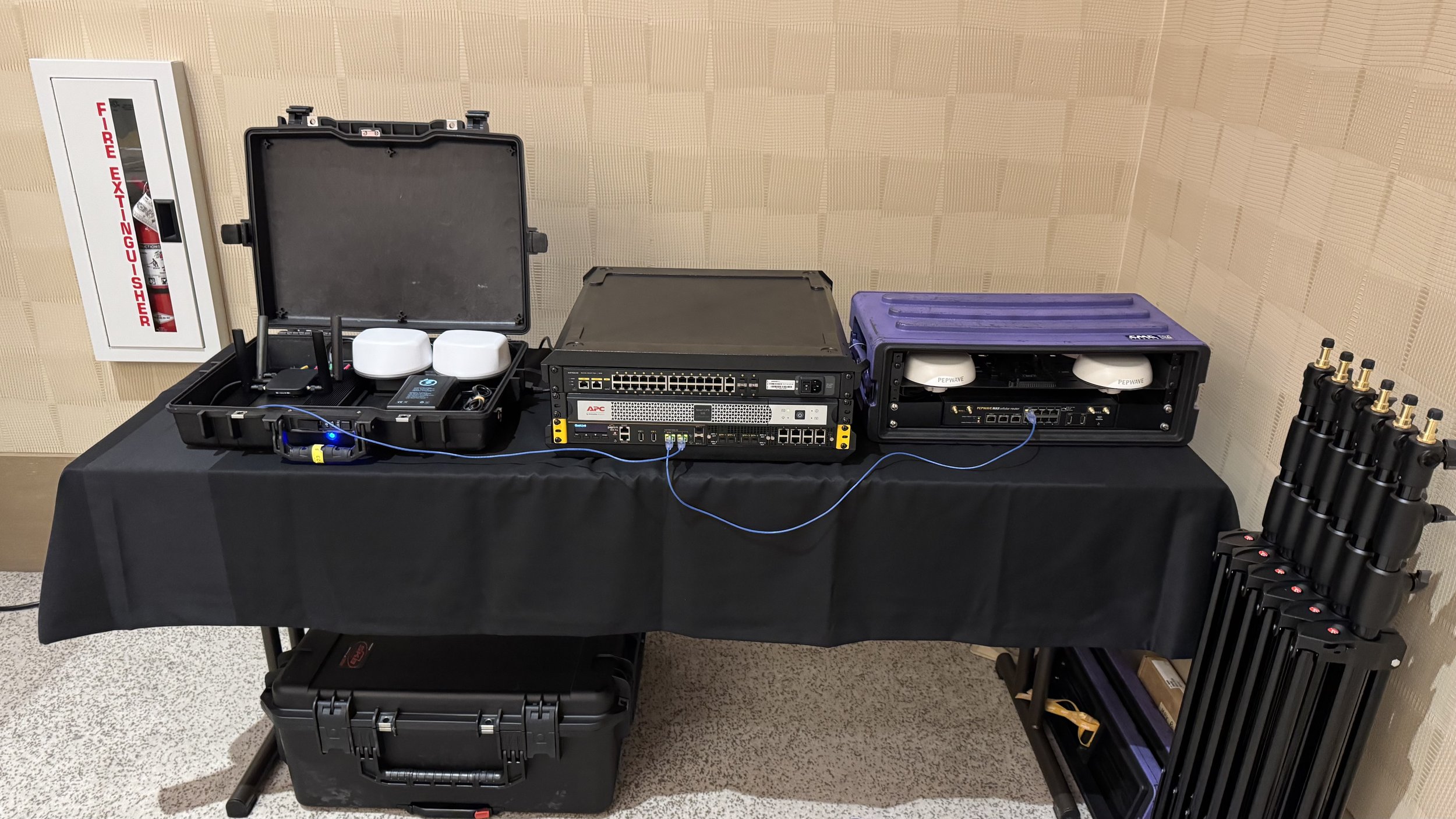
The Portable Network Operations Center (NOC) Backstage at the event
At Talon Audio Visual, we know that a reliable network is essential for any successful event. When a client planning their national managers’ conference in Anaheim, CA approached us with a unique event networking challenge, we were excited to deliver. The client’s strict data security policies prohibited corporate devices from connecting to the hotel’s WiFi network, but they still needed a secure, high-performance internet solution for both attendees and for our onsite production team managing the audio, video, and lighting for the event.
To address these requirements, we engineered a private network that operated independently of the venue’s infrastructure. Leveraging 5G networks from all three US cell carriers, and bonded cellular technology from Peplink, we provided a fast, reliable, and secure network that exceeded the client’s expectations.
The Challenges
Data Security: The client’s strict corporate IT policies meant we had to be entirely separate from the hotel’s internet connection, and that we needed to isolate client devices from each other and from production machines. We also needed to support client PCs with a corporate VPN.
High Bandwidth Demand: Supporting internet access for hundreds of attendees while meeting the needs of the production team to download and upload large media files, while ensuring consistent performance across devices.
Temporary Setup in a Busy Venue: Designing and implementing a robust network within a short timeframe, all while ensuring it seamlessly, if temporarily, integrated into the event environment.
The Solution
To meet these challenges, we deployed the following:

A Wireless Access Point on a stand in a hotel ballroom.
Peplink Network Backbone: A powerful system to handle high volumes of traffic. Using a Peplink SDX Pro as the core router, we built a temporary NOC in the backstage Video Village tech area that managed the network building-wide.
Ten Cellular Modems: Bonded to combine bandwidth from multiple 5G providers for a reliable and high-speed connection.
WiFi Access Points: Strategically placed around the venue to provide seamless coverage in all event areas.
Temporary Cabling: Carefully routed to connect the entire setup without disrupting the aesthetics or flow of the event.
Device Isolation: A critical security feature to ensure corporate devices couldn’t communicate with other endpoint devices on the local network, protecting sensitive data.
The Results
The result was a secure, high-speed private network that supported all aspects of the event. Attendees enjoyed reliable WiFi access for work, email, event polling and engagement, while the production team leveraged the robust network for video streaming, AV integration, and other resource-heavy needs.
Technical Highlights
5G Cellular Bonding: Combined multiple connections to create a fast, redundant, and reliable internet experience.
Advanced Security: Delivered a network that complied with the client’s strict IT requirements, including device isolation.
Event-Specific Design: Tailored the setup to the unique needs of the conference, ensuring flawless execution.
Our team’s expertise in bonded cellular and 5G technology broadly, and in the Peplink Ecosystem specifically, not only addressed the client’s challenges but also enhanced the overall attendee experience. The event went off without a hitch, with both the client and attendees benefiting from the secure, high-performance network.
At Talon Audio Visual, we specialize in creating customized solutions that meet the unique needs of live events. Whether it’s building a secure network, delivering seamless AV integration, or providing full technical production services, we’re here to ensure your event is a success.
Want to learn more about how we can power your next event? Contact us today to get started.

Technical Production for a Tech Company User Conference on SF Pier 27

In the Fall of 2024, a leading tech company hosted its first in-person conference at San Francisco’s Pier 27, blending on-site and virtual experiences via the GoldCast platform. Working with our agency partners, Talon AV led the technical team across departments and vendors to make sure every technical detail was spot-on.
Comprehensive Technical Oversight
We handled a range of technical elements and departments, from Audio Visual, to Lighting, to Power, to Network.
Video & Audio: Oversaw audio building-wide, including general sessions, breakouts, and paging, and oversaw video for both in-room screens and live stream, to ensure high-quality visuals for both on-site attendees and the online audience, giving everyone a unified experience.
Network Coordination: Coordinated with the in-house IT team, AV team, registration vendor, and production teams to set up a robust network that supported both the event’s internal needs and the live stream for virtual attendees. This meant planning in advance for internet access in hard-to-reach outside locations, as well as managing multiple networks for attendees, presenters, and production staff.
Power Distribution: Carefully planned power needs between vendors and the venue’s preferred electrical vendor to supply power to everything from catering to AV to expo to lighting, ensuring everyone had a great experience.
Lighting Design: Worked closely with the design team and AVL Vendors to create lighting that not only lit up the venue but also matched the event’s branding and themes - we paid meticulous attention to color temperature, focus, and locations to light everything just right
Logistics Management: Coordinated load-in and load-out schedules with the producer and all vendors, collaborating efficiently with production teams, client, venue, and vendors to ensure timely setup and teardown.
Design-Centric Approach
Knowing the client’s focus on design, we paid special attention to elements like set design and lighting color temperature. Our aim was to create a space that was visually appealing and aligned with the event’s goals. This meant choosing lighting colors that complemented the set design, but still worked for the cameras, ensuring both in-person and virtual audiences had the best viewing experience.
Seamless Hybrid Experience
A key aspect of this event was its hybrid nature. We made sure virtual attendees felt just as engaged as those on-site. By leveraging both the GoldCast platform and YouTube, we delivered a live streaming experience that was interactive and immersive, allowing remote participants to engage with the content effectively.
Tight Onsite Window
With only 36 Hours onsite, we had 24 hours to build the event, and 12 hours to take it all down. Coordination between vendors, venue, and production teams was crucial to pulling it all together on time.
Collaborative Effort
The event’s success was a result of the teamwork between Talon Audio Visual and our Agency, Client, Venue, and Vendor Partners. Our shared goal was to bring the client’s vision to life, down to the last detail. In the end, the event was a big success, with great feedback from the client and attendees. At Talon Audio Visual, we take pride in teamwork, in managing complex technical requirements, and in keeping an eye on aesthetic excellence, ensuring every event we handle is both operationally sound and visually captivating.

Project Spotlight - 2024 AI Engineer World's Fair - San Francisco, CA
Talon Audio Visual was proud to support the biggest technical AI conference in San Francisco, CA - the 2024 AI Engineer World's Fair. This marquee event brought together leading AI companies, founders, VPs, and engineers, featuring over 30 companies on the exhibit floor and more than 100 speakers delivering live talks and workshops to approximately 1,500 in-person attendees and thousands more online.
Talon Audio Visual provided technical production services and oversaw all audiovisual technology for the show. We also provided the Show Caller for the General Sessions and managed a team of a dozen breakout producers and over 40 union technicians and stagehands who covered 11 different rooms.
Challenges and Solutions
The project was daunting, requiring hundreds of hours of pre-production planning. Our production team faced several challenges, including multiple sessions, mid-show program changes, and unique tech needs. Here's how we tackled them:
Managing Multiple Sessions: With 11 breakout sessions and a General Session that split and re-combined twice a day, keeping everything running smoothly was a significant task. We succeeded through careful planning and quick adjustments.
Last-minute Changes: Our team handled numerous last-minute speaker changes and content updates. This required coordination between Talon, our partners, and the many producers and technicians. It also meant many live updates to the run-of-show. Our teams coordinated with presenters and producers to ensure seamless updates without disrupting the ongoing show.
Specialty AV Needs: The tech-heavy show featured many live demos requiring rock-solid network connections, complex AV routing, and custom audio filters. Our team collaborated closely with speakers on their last-minute needs and handled these unique requirements with ease, ensuring every demo went off without a hitch.
Teamwork
The success of the event was a true team effort, involving:
Argus HD Event & Digital Productions: The AV team from Argus HD and their partners provided solid leadership and expertise.
IATSE Local 16: The union technicians and stagehands showcased their skills and dedication throughout the event, and made the show possible.
San Francisco Marriott Marquis: The Banquets and Event Services Teams at the Marquis were incredibly helpful, adjusting room setup and reset times, crew meals, and security schedules to support the production, and the in-house IT Team provided consistent network support throughout the event.
The entire production team managed the show and navigated challenges with confidence and grace. The AI Engineer World's Fair was a tremendous success, thanks to our team’s and our partners’ hard work and support. The event's complexity and scale pushed us all to grow, and demonstrated the strength of our teams. Together, we delivered an exceptional event and we are excited to deliver an even better show next year.
Networks, Streams, Signage, and More for a Nurse's Convention in New Orleans
Networks, Streams, Signage, and More. That’s what Talon AV provided to the National Nurses United Conference 2024, held this year in New Orleans, Louisiana.

Did you know that about half of Talon’s work is managing specialty scopes for our AV and Agency partners? As a strategic outsourcing partner, we take on complex technical scopes for our partners and their clients, allowing them to focus on their core areas of expertise while delivering complex and flawless shows to their clients.
Earlier this year our partners Metro Media Productions came to us with just that sort of ask - interface with the in-house network team, the client’s IT department, and the multiple production vendors on the project to ensure the packets were flowing. Also can you provide a digital signage solution that showcases user generated content along with the daily agenda? And oh by the way, we need a cellular backup network for the VIP board meeting’s Zoom Call.
We got you Metro!
Coordinating with Encore Global, the in-house AV and Network vendor at the property, we optimized the network order for the multiple network needs that the show had - from registration, to production, to attendee WiFi. We provided a Peplink bonded cellular solution for the board meeting, as well as network infrastructure building-wide including Netgear AV managed switching to distribute multiple vLans from the house network to the various production needs.
On the signage front we provided Brightsign players, on a mix of wired and wireless connections, to display daily agendas above live-updated social media content, and provided networking support to the AV, Lighting, and Video teams from Metro, 4Wall, and Proxy AV.

We provided Epiphan Pearl encoding to deploy overflow, green room, and client office feeds over IP, along with Zoom feeds for staff on and offsite to monitor sessions from their personal devices. You want that Zoom feed in 1080p? Don’t worry, it’s already enabled on all of our accounts!
From IT support, to streaming, to signage, to accessibility - captions, interpretation, etc., we’ve got equipment, staff, and key vendor relationships to deliver key technical expertise and support and ensure that your events go swimmingly - whether we provide the whole AV package, or we support agencies and AV companies that just need a bit of help.
Outside Looking In - a vendor perspective on event production for internal production teams
In Spring 2023, I had the opportunity to present at the University of California Video Producers Conference. This annual event brings together video and production professionals from all over the University of California System to share resources, reconnect with colleagues, and inspire each other with new ideas. As a founding member of this group, I was asked to come back as a featured guest speaker and present to an audience of my former colleagues with an outside perspective on the work we share.
Talon Audio Visual's Crucial Role at a San Francisco Healthcare Professionals Conference
In the heart of San Francisco, at the iconic Moscone Center, the stage was set for an international healthcare professionals conference. Behind the scenes, Talon Audio Visual was hard at work supporting our partners at Metro Media Productions ensuring one of their flagship projects was a resounding success.
We were tasked with managing digital signage, Zoom calls, breakout recordings, bonded cellular networks, and live streaming.
Digital Signage: Setting the Stage
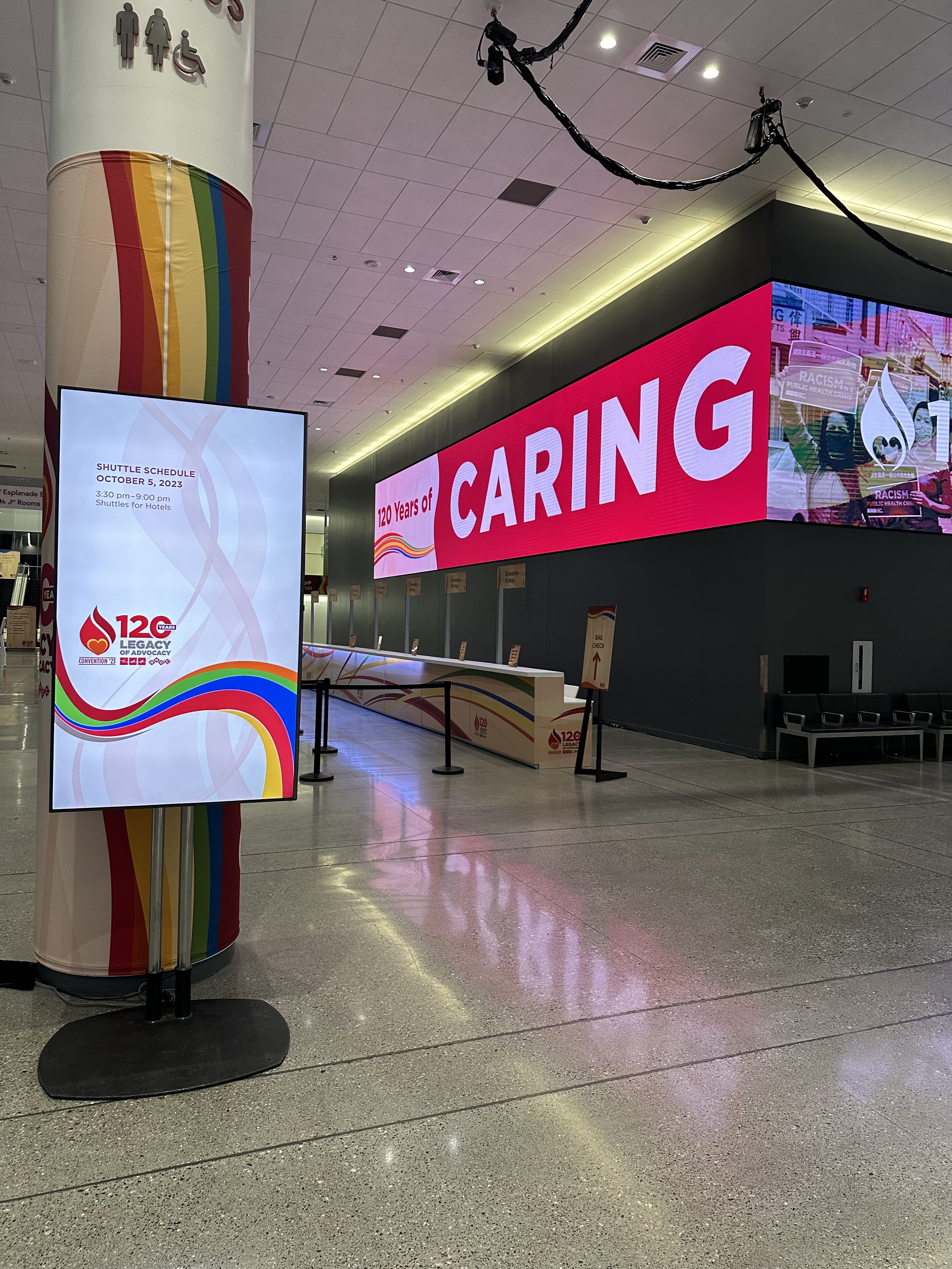
To set the stage for the conference, our clients wanted to transform the Moscone Center into an immersive experience. Talon’s team managed digital signage, which included both venue and temporary monitors, LED walls, and BrightSign digital signage players across the venue. We curated content in multiple formats, resolutions, and aspect ratios, incorporating timed updates and live social wall content on the displays. To add an extra layer of dynamism, our team also crafted animated motion graphics content for the massive LED screens in the lobby and projection in the expo. The result was an electrifying atmosphere that captivated attendees and set the tone for the entire event.
Zoom Calls: Bridging Language Barriers
In today's globalized world, language should never be a barrier to understanding and collaboration. For this event, our team handled Zoom calls that provided real-time human language interpretation across multiple rooms. This service extended to the general session and an evening outdoor live performance, ensuring that every participant could engage and comprehend the proceedings. With the power of technology including Zoom, Talon’s hardware and support, the RSI Exchange interpretation app, and a global team of live interpreters from Tiller Language Services, we brought the world together under one roof.
Breakout Recordings and Quick Edits: Capturing Every Moment
In a world that moves at the speed of light, we know the importance of preserving valuable content. Talon Audio Visual took charge of recording and quickly editing breakout sessions. This meant that attendees who couldn't make it to a particular session didn't miss out. Our team's dedication to prompt delivery ensured that the conference's impact reverberated long after its conclusion. Using remotely managed recorders from Epiphan, the files were automatically uploaded to the cloud for our editor to start working on right away.
Bonded Cellular Network: Connectivity Beyond Boundaries
For an outdoor event, we had the unique challenge of setting up a bonded cellular network. This network was responsible for production networking, Zoom uplink for interpreters, and providing attendee Wi-Fi for 300 users of the interpretation app. We had to ensure that this network was robust, reliable, and could withstand heavy traffic.
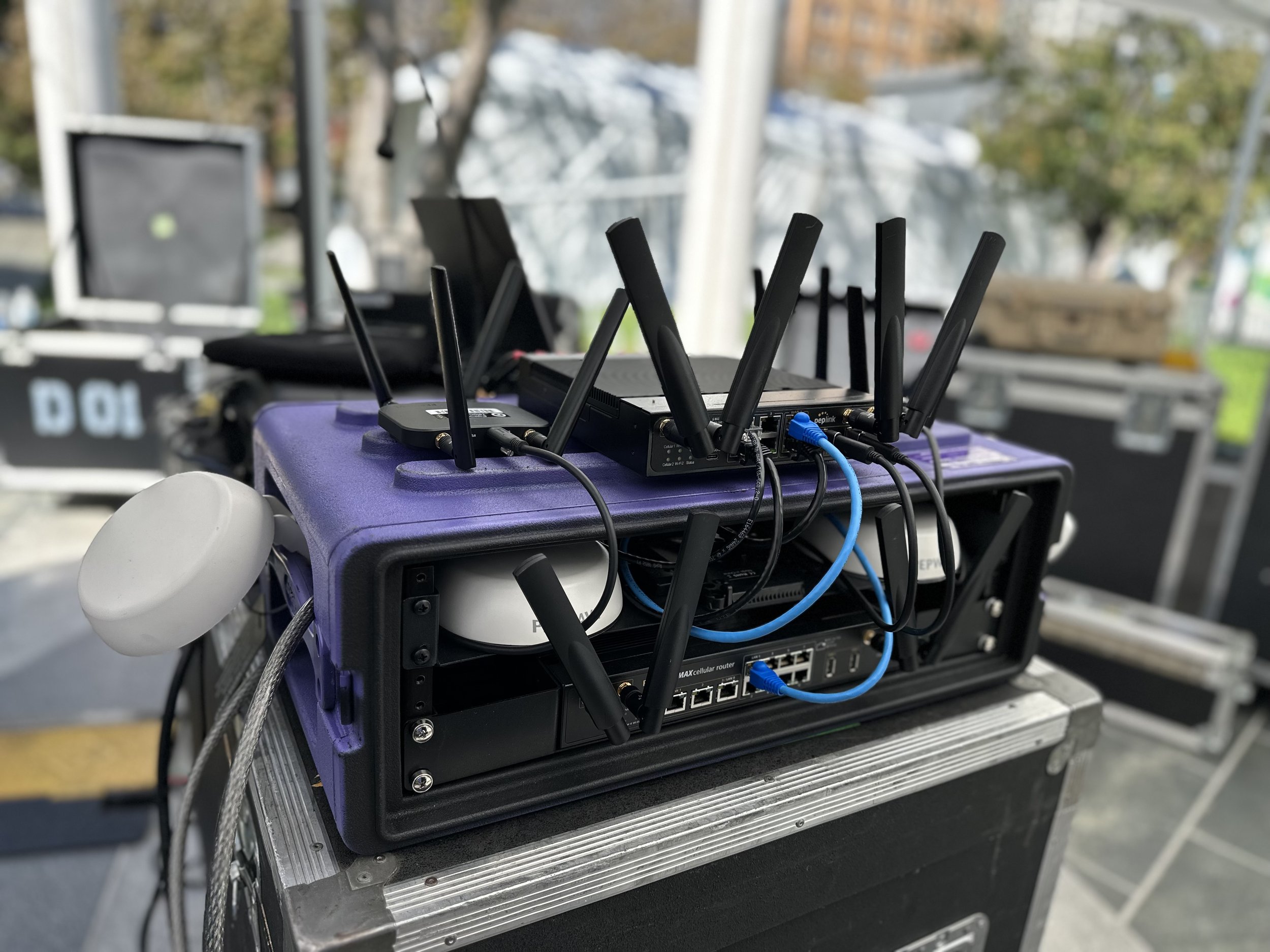
With 12 cell modems across all three major carriers, six Wi-Fi access points, and a fiber truck between event areas, we created a network that could handle anything thrown at it. The evening before the event, the client informed us of an unexpected increase in the number of translation app users, almost six times the original estimate. We responded with extensive testing and traffic shaping, scaling up the network to accommodate the surge in demand. The result was a seamlessly connected outdoor event that went off without a hitch.
We also provided bonded cell backup networking for key sessions inside the Moscone Center ballrooms during the event.
Livestream Uplink: Sharing the Experience with the World

Finally, to share the conference with a global audience, we managed a livestream uplink via TVU bonded cell video link. This link connected to a master control room where livestream encoding, management, and recording took place. We also had a distributed remote engineering team monitoring the stream. With their expertise and vigilance, we ensured that the conference was accessible to those who couldn't attend in person.
Our Dedicated Team:
Tim Kerbavaz - Technical Producer: Tim Kerbavaz, a seasoned professional in the audio-visual industry, took the lead on this project. As the Technical Producer, Tim was responsible for overseeing pre-production, gear specification, and acted as the onsite manager and client contact. He also managed the streaming and networking scope for the event.
Ryan Behrmann - Zoom and Breakout Recording Lead: Ryan Behrmann assumed a critical role in managing Zoom calls and breakout recordings. She spearheaded a team of six local technicians and collaborated closely with the General Session and Breakout operators to ensure that Zoom calls were seamlessly connected and presented in a way that was both visually and auditorily appealing. Her expertise was instrumental in bridging the gap for international participants.
Jack McRoberts, Networking Lead: Jack McRoberts and his company Copano Media Group provided invaluable network support and additional network hardware to ensure that the increased network demands at the outdoor event ran without a hitch. Jack’s expertise in network management and dedication to ensuring a seamless online experience for attendees made a significant impact on the success of the event.
Our management of digital signage, Zoom calls, breakout recordings, bonded cellular networks, and livestream uplink was only a small part of a bigger production, and we know that the success of this event was a collective effort. Talon Audio Visual was proud to play a pivotal role in supporting Metro Media as they exceeded their client’s expectation.
In the world of live event production, we understand that no two events are alike. Each brings its own unique challenges and opportunities. Our experience at the Moscone Center underscores our commitment to pushing boundaries and delivering seamless, immersive experiences for our clients and their attendees.
As we reflect on the challenges and achievements of this event, we acknowledge the dedication of our team members. Tim Kerbavaz, Ryan Behrmann, Jack McRoberts, and our animator Ray Tarara, along with the rest of the Talon Audio Visual and Metro Media Productions teams, demonstrated unwavering commitment to the success of the production, contributing to the overall success of the conference.
As we look ahead to more events and adventure, we look forward to more opportunities to collaborate and deliver excellence in audio-visual support at future events. You can rest assured that Talon Audio Visual will be there, ready to tackle complex challenges and exceed expectations.
Production with Pride - Davis Pride 2023
It may no longer be June, but Talon Audio Visual is PROUD to be a long time partner of the Davis Phoenix Coalition and Davis Pride - we've been providing the production support to the Davis Pride Festival for many years. Here's a little recap of the fun we had in June!
Raising Funds and Ensuring Access - Captioning and Accessibility Consultation for Children's Miracle Network

When your mission is ensuring that 10 million children receive life saving hospital care each year, you have to sweat the small stuff. Details matter to Children’s Miracle Network, the nonprofit organization that raises funds for children's hospitals across the U.S. and Canada. Among those details are accessibility and equity, areas in the core focus of Talon Audio Visual’s Accessibility Consulting Services. In the Spring of 2023 Children’s Miracle Network Hospitals hosted their 2023 Hospital Week event in Sunny Orlando Florida, and reached out to Talon Audio Visual’s Talon Access Service to help ensure that the event was accessible to all their attendees.

Part Telethon, part healthcare industry conference, with a dash of esports, and a live performance from Andy Grammer, it was quite the event. Talon AV / Talon Access provided live human-generated CART captions in the General Session, including for the live musical performance, along with Automatic Speech Recognition Captioning Support in the breakout sessions, and an event-wide accessibility review post-conference for the client and their production teams.
We got great feedback from the Children’s Miracle Network Team, as well as from our partners on the event, one of whom was so blown away she asked us if we could “be [the accessibility] techs for all of our conferences and events? You’re the first I’ve seen that TOTALLY gets what we need to do our job the best we absolutely can.”
At Children’s Hospital Week 2023, Talon AV helped make the great work of Children’s Miracle Network hospitals accessible to all. The positive feedback we received is a testament to Talon AV's expertise in providing comprehensive accessibility solutions.
At Talon Audio Visual, we understand the importance of sweating the small stuff to create meaningful experiences. We invite you to reach out to us for more information about our Talon Access accessibility consulting services. Let us help you ensure that your events are accessible to all, leaving a lasting impact on your audience. Reach out to us today for more information and let's work together towards a more inclusive world.
Awards Season? Let's Get to it!
It’s Awards Season, so here’s a throwback to the UC Davis Alumni Awards, A Night At the Aggies.
Throwback Movie Night!
Talk about #ThrowbackThursday - what about a whole 1950’s drive-in themed gala? We made some cusom “pre-roll” video content as part of a drive-in themed gala for UC Davis - check out the on-brand opening slideshow here.
AV With Pride - Recap of Davis Pride 2022
As June comes to a close, I know we all have a lot on our minds, but I wanted to take a moment to look back and celebrate as we wrap up Pride Month. I know many large cities just celebrated their Pride festivals this past weekend. Here's a look back to a couple of weeks ago when Talon Audio Visual helped celebrate pride in Davis, CA. As an LGBTQIA-owned live events business, Talon Audio Visual has been proud to be the production partner for Davis Pride since 2015, and I look forward to many more years of a successful and growing festival. Hope you enjoy this look back at Davis Pride 2022. This video is #captioned
Thanks to Jolie Media for the great sizzle reel.
Video Description: A colorful review of the Davis Pride festival, this video opens with footage of the AV team setting up speakers and equipment and then transitions to colorful footage of the performers and audience at the festival. The video ends with Tim, dressed in black, speaking directly to the camera.
Congrats Grads! - Graduation 2022
A video recap of Talon Audio Visual's production for the DaVinci Charter Academy Graduation in Davis CA
Event Deep Dive - Google I/O 2021
By pulling back the curtain on event production, Tim & Tim Talk seeks to entertain and educate our audience as we explore new ideas, technologies, and techniques. Throughout this series, we share ideas to increase your ROI and engagement and improve audience experience for your events. As passionate event professionals, Tim Kay and Tim Kerbavaz are long-time friends and collaborators with over 5,000,000 viewer-hours of live event streams under their belts. Our work spans from Fortune 100 conferences, to higher education and product launches, with audiences up to 30,000+ attendees in person and 100,000+ online viewers.
In this 4-part series, with Tim Kay and Tim Kerbavaz, Take a peek behind a production curtain that few get to experience and even fewer share how it's done! In what may be the first of its kind, we will walk you through what it took planning and executing one of the highest profile Developer Conferences in a fully virtual event model.
Guest Appearance - The Pixilated Podcast
Tim was a guest on The Pixilated Podcast, the only podcast dedicated to bringing daily interviews, tips, and technology for event marketing professionals from seasoned event professionals and entrepreneurs.
Tim was a guest on The Pixilated Podcast, the only podcast dedicated to bringing daily interviews, tips, and technology for event marketing professionals from seasoned event professionals and entrepreneurs.
Podcast Transcript
Patrick Rife (00:07):
Hello, and welcome to another episode of the Pixilated podcast. I am your host Patrick Rife, CEO here at Pixilated. Bringing you another episode in our interview series for those of you who have been tuning along this season, you know, that we have been focusing on interviewing tons of amazing people throughout the event, prof diaspora season one Saw us doing a lot of that and then also a lot of other kind of content pieces. But with this season we wanted to really just focus exclusively on connecting with other people building our relationships, and then also like capitalizing on all of this amazing knowledge that people in the events industry have that maybe doesn't make it out to see the light of day as often as it should. So without further ado, I want to welcome Tim from Talon Audio Visual to the call today, Tim, welcome to the Pixilated podcast.
Tim Kerbavaz (00:59):
Hey, thanks so much for having me. It's great to be here. That event prof diaspora. I like that term, certainly over the last, you know, couple of years, we've definitely seen our industry kind of splitting and dividing and in, in many cases folks leaving. And so I think as you rightly point out, this is the chance to kind of reconvene as an industry and kind of come together and share our lessons learned and growth together.
Patrick Rife (01:27):
Yeah, yeah. And apply all the, we gotta rewrite the rules again for three years in three years. Yeah. Well, so Tim, before we get into, I got a bunch of questions I'm super excited to dig in, but I like to just try and like seed the floor right off the jump because nobody can kind of frame up who you are and what you do better than yourself. So why don't you let everyone know kind of, you know, who you are and a little bit of your, you know, origin story and then we'll get into some questions.
Tim Kerbavaz (01:52):
Yeah. So I'm Tim Kerbavaz. I am the owner of Talon Audio Visual, which is a, you know, production company based in California. Although I say that with some hesitation, because as we talk about kind of evolving landscapes of events and what I do has evolved tremendously in the last few years. You know, I got my start in, in AV as a, you know, child. You know, I remember going to Radio Shack with my grandmother to pick up my, you know, Christmas, present a microphone from Radio Shack. And and that being sort of this thing that I was super excited about and, and literally, you know, it is all downhill from there, you know so much for, you know, being a lawyer or a doctor, I guess, but you know, in terms of that level of kind of delight and excitement has, has stayed with me and I really do love the work that we do as an industry.
Tim Kerbavaz (02:45):
And I think that we do create the light and magic for our customers to what I do specifically and kind of what my work has evolved into. It's been a mix of, you know, I mean, I started out as a, you know, basically a local Retnal and Staging company in Davis, California, and grew over the, the years into sort of a regional provider. And then what I do now has evolved into much less providing equipment and much more providing sort of consulting services and, and production support. So I call myself a technical producer. I work both with my own direct clients and with other production companies and agencies producing events. And one of the things I specialize in particular is event accessibility and localization. So specifically live broadcast captioning and live broadcast translation and localization. And, and so looking at, you know, broadly kind of making events, accessible, making events understandable to your audience is, is something that's super, both interesting to me.
Tim Kerbavaz (03:41):
And, and something that has carried through my career, I've worked you know, in kind of accessibility broadly for, for a number of years. And one of the things that I see as we come into sort of back into ballrooms in person events is that I don't want to leave behind all of the people that we've been able to include with virtual events. And, and I, when I say that virtual events have allowed folks who can't necessarily travel or attend in person for a variety of reasons for, you know, disability for financial reasons, for childcare reasons, for you know, just PAC schedule and can't afford the travel day reasons. There's so many people that are able to be included in virtual events that cannot probably come to our in-person events. And so one of the things I'm interested in as we look at kind of this return to, to events in the ballroom and kind of what does the evolving event landscape look like really is how do we make sure that everything we do is adding to our audience, adding to our inclusivity and not taking things away that we've sort of given people accidentally in some ways.
Patrick Rife (04:45):
Yeah. Yeah. Awesome. What a great, what a great summation I wrote down, you like tweaked my brain in a, in a few different ways. And, and one I want to get to back to, but, but poignantly, what you were just mentioning, you know, like this, you know, like the accessibility element, right? The way that it really kind of changed things up. And at first we just, we, we really tended to focus on it a lot through the lens of, you know, like, oh, well, there could be people that are interested in, you know, like for whatever, for a large nonprofit organization that serves, you know, like a very specific kind of cancer, right. That ha that could have a global audience, but it happens to be based in like Des Moines, right? So like the people that are interested or impacted by it, you know, they aren't able to come, but the other side of it is, is accessibility.
Patrick Rife (05:31):
Like doesn't just have to be geographic problems, right. Accessibility is a far broader conversation. And I think it's interesting that you mention that because a previous guest of ours makes stray, she works in sustainability and is based in the UK. And I saw you know, like funnily enough a Twitter thread recently from her talking about the lack of closed captioning being brought into the live event space again, and how, you know, like over the past two years, that gap has been able to be bridged for all of those people who were maybe not thought of previously, because it was convenient to the way that software was working. And maybe we didn't notice it as much before, but now that you have been able to be in that environment and you're back in this live space, and it's not closed, caption, people are raising the flag and saying, wait, you you're missing something that was actually really valuable to us. And, and by the way, it's not negotiable anymore. Like we need you to figure out how that comes in. So I'm curious one, if you saw, I, I think you're probably connected with Meg or at least you're seeing some of her stuff, but I'm curious if you saw that thread or, or have any thoughts about that.
Tim Kerbavaz (06:45):
Yeah. I, unfortunately I missed that thread. I, I am fairly active on Twitter, but in sort of, I think a different circle. And, and so but to that point, I mean, you know, when we talk about accessibility broadly, right, we mean, you know, the ability to access, whatever, right. But there's so many facets to that, particularly in the event space. And as you point out with captioning specifically, which is something that I've been working on for for many years is that, you know, there's all these tools to sort of automate AI based captions for web broadcast. And those tools aren't necessarily as easy to implement in person. Now, I would say I do not really think that AI captions are adequate. I'm actually using them right now in our meeting just to follow along. But I, I do think that you know, if you have an event and audiences that need captions, you really need to pay for human captions and that's captions are generated, live with a human stenographer.
Tim Kerbavaz (07:44):
So like a court reporter, someone who uses like a stenographic cord based keyboard to type, you know, two, 300 words a minute, and, and that works in person just as well as online where you have a stenographer sitting either backstage or remotely, and then their, their texts coming up on typically like screens. And I've done that a lot with either in big, big spaces. You'll do like a ribbon display across the top or bottom of the big projector screens or the, the L led walls for smaller events and, and theaters. I've done like 70, 80 inch TVs just sort of flanking the stage in the orchestra. So, you know, sort of the best seat for captions would be like the orchestra seats. But I do a lot of did in the, in the previous, the, you know, before COVID times a lot of events where we had, you know on onsite screens.
Tim Kerbavaz (08:26):
And I wanna clarify, so when we talk about captions and the UK uses a different terminology here, but in the us when we talk about captions, there's open captions and closed captions, just a little trivia here, closed captions are like on your TV, where you can turn them on and off, there's a button. So whether it's in your YouTube player or on your television, that you can make them go away. Open captions are part of the video, like burned into the video. They're, they're actually just always visible to everyone. And closed captions are metadata. They're not actually part of the video signal. They're, they're basically text data sent along with the video, just a point of trivia there.
Patrick Rife (08:57):
<Laugh> awesome. Awesome. That's a good piece of clarification. I I didn't realize the, the difference between the two, although I definitely am familiar with each one. So that, that, you know, like I think that, I think that that's an interesting, you know, an interesting point and, and you know, what that means, right. Is investing in, in more, an infrastructure and more production to be able to meet that, right. Like that's an additional person, you know, and, and I think that one of the things that we're seeing already, and I think that it's, it's unfortunate, but I'm already seeing lots of clients that are immediately reverting back to live events, and they're just lopping off the virtual, you know, and they're, they're trying to treat it like it's a, you know, an aftertaste that they're ready to, to to dismiss. And I find it to be a bit shocking because, you know, I, if there's one thing that was true is like your audience that was there for your live events in 2019 was not the same audience that you have been directing your, your events to for the last two years, there's a portion of them that are, are there, but every person that migrated had to build a new audience in some regard or another, and what I thought would happen is I really thought that people would glean to this idea of as opposed to producing a live event for this, like set audience, this whole, you know, concept of an ongoing community, right.
Patrick Rife (10:32):
That you're producing content for. And you're making sure that it's available, whether it's in virtual or it's live, or it's, there are hybrid things tying together. And the, but the reality of that is, is now that live events are starting to turn back up these planners. They don't have the resources to be able to do that, and they're having to pick and choose because as you know, very well, you can't take a planner that was responsible for producing event in one arena. And all of a sudden have them be able to produce an event in two arenas that have all different tools and resources. So curious what you're seeing, you know, in regards to that.
Tim Kerbavaz (11:11):
Yeah. You know, I definitely see that where folks are kind of just reverting back to sort of the way things were or the way they sort of used to do things. And, and I understand why, right, as you point out it's, it's resources, it's budget, it's bandwidth as the, you know, event professionals just can't necessarily manage effectively two events at once. And, and so, you know, I think from a, an event professional perspective, I understand why people are doing that from a client perspective. It's super frustrating because I understand that these things cost extra, but I think there's, there really is so much ROI to be had for, you know, adding, you know, maintaining virtual options, maintaining virtual presence, as you said, maintaining online community that keeps that conversation about your company and your product going. And, and I think it's kind of a communication issue of, you know, are we as an industry adequately defining and communicating that real ROI to our clients so that they come up with more money because obviously, right, I can't expect an event planner or a producer to, you know, just magically, you know, make resources appear.
Tim Kerbavaz (12:20):
You know, but I think, you know, part of the challenge, not necessarily as an individual, but as an industry is kind of making that case to our clients about, you know, why you know, maintaining virtual options matters why accessibility matters, why, you know, having captions in your theater or ballroom matters. And, you know, these are all things that are not free, but, you know, I think that there's real reasons that, you know, these things matter both to audiences and to clients. And, and so part of it is gonna be really defining for whom on the client side, each of these various opportunities has the best ROI and then really making that case to them about, you know, for you, why this is the case. And I can say that, you know, the big tech companies are not rushing back to in person events, you know, they're having in person, no, and to some degree, but you know, the big tech launches, I mean, apple is doing all their keynotes, you know, remotely, or, and, and frankly they're, you know, they're you know, just, you know, basically TV show, right.
Tim Kerbavaz (13:24):
And, and I think that I've heard from audiences that, you know, they think the apple keynotes are better now than they have ever been, but it's because they're producing it like a TV show, not like a conference, it's not a press conference anymore. It's, you know, it's, it's a, it's a movie. Right. And so I think one of the things that changes in terms of the way you approach online events versus the way you approach a ballroom event is you don't have a captive audience right now. And I think that in person events often get away with being boring or, or really not engaging because your audience is physically stuck in the ballroom with you and they can't leave. And so it doesn't actually mean they're necessarily paying attention. It just means you they're physically with you, whereas online you're audience, so many other competing, you know, interests right.
Tim Kerbavaz (14:17):
Or competing meaning for their attention that you really are forced to really be compelling. And, and I think when we look at what is a model of a compelling broadcast first event that happens seven days a week, it's your local TV affiliates, nightly news, right? Where they've got a show that has a formula that they have honed over decades to make work, you know, to capture attention. They have you know you know, a host segment that introduces the show. They have remote guests who are reporting from the scene. They have prerecorded video segments, buffering, live segments. They have, you know interstitial segments. They have the weather, right? All these various components that keep the show engaging in dynamic. And I think as a virtual event, that's your model of what a virtual event should look like. It's, it's the news.
Tim Kerbavaz (15:09):
It's not, you know, what your conference used to look like in person. So the challenge is, as we look at, how do you translate that to an event that is both in person and online is how do you maintain the compelling, you know driven, you know, driving timeline of the virtual event while also like giving your in-person events, attendees, a lunch break, right. You know and letting them stop for coffee. And so I, I think, you know, when you're looking at it, it really is kind of two different formulas, but I also think that in-person events could by and large afford to be much more engaging. And I, I, I think that a lot of virtual events have been, or sorry, a lot of in-person event rather have been coasting on the fact that they have a captive audience. And, and I think, you know, a lot of in-person events could, could stand for some shake up too.
Patrick Rife (15:55):
Yeah. Yeah. Couldn't agree more. I couldn't agree more well. So, you know, one of the other things that you said in your intro that I that I would be remiss not to go back to is, is radio shack. You know, like I, I think that that there are certain P people of a certain age will understand what that reference means. You know, like radio shack used to be the place where you could go and get transistors and they had, you know, like little bins of bots and bobs and like all of those things. And, and it was also like, you know, you go look, look at a Tandy computer, like floppy discs, like all of those, you know, like there's a lot of, you know, it's like black light posters and a Spencer as well to a degree, but there's also that thing, you know, it's kind of like the same way that sunny surplus used to be.
Patrick Rife (16:44):
I don't know if you guys have the middle on the east coast, we had a store called sunny surplus and it was like legitimate army surplus, like canteens. And it was like all a buck and 70 cents. Cause it was just all this like war gear <laugh> that was like, we gotta get rid of it, sell it to the public, it like, you know, pennies on, on the dollar. But there were, you know, those kind of stores, right. That open up access to those bits and bobs that allow a curious kid to come in and, you know, like all of a sudden run his RA, his radio and a microphone into one place and then have a single output and be able to like, you know, produce your own broadcast. I was very much that person as well. So I just, you know, talk a little bit about that. Talk about, you know, like your, that, that, you know, that hook in your mouth that kind of just came along. Yeah.
Tim Kerbavaz (17:31):
So, I mean, I think as you say, I mean, radio shack was this as much as it was, you know, sort of, and at the end, particularly kind of this seemed sort of corporate store it brought into almost community access to electronics and access to electronics, you know, when it started and, and its heyday at a time when there was not necessarily a lot of consumer access to technology to electronics, right. There were dedicated electronic stores where there was like an old dude behind the counter and you walked up and you're like, I wanna, whatever. And he layers at you as he finds it in the back, you know, the radio shack model that you could walk into a store and just Rumage through bins. And there was all sorts of, you know, cool computer and electronic and stereo gear on the shelves.
Tim Kerbavaz (18:23):
And, you know, and, and you, I mean, ham radios for that matter, right. The CB radios and, and, and having just access to that level of technology in the shopping mall, in, you know, the, the corner of the main street, you know was definitely, you know, a, a huge part of my childhood, like going to radio track was like an event, right. As a, you know, as a kid. And, you know, I mean, whether it was for, you know, some, a little resistor baggy for some project or whether it was just to kind of OAL at the, you know, the, the stereo systems, it was you know, kind of this window into the world of electronics in kind of local accessible way. And, and I, this is a, a west coast thing, but Fry's electronics is, is, is similar in the sort of big box store model.
Tim Kerbavaz (19:11):
Okay. Which unfortunately just went outta business. But you know, Fry's had that kind of, you could walk in and anything with electricity in, it was in this one store and that kind of sort of heyday of consumer electronics in some ways you know really, I think inspired me and I think other people in terms of, you know, being interested in and being able to kind of visualize what, you know, the world of electronics looked like, and for me, that, that went into kind of the world of production. And I could say, you know, and I always, whether it was at a science museum or at a theater or movie, or, or play, or, you know, at the amusement park, I was always peering around corners and up in the ceiling. And, you know, I still, I cannot go to a play without staring at the lights, you know, and, and it just, you know, that I've always been captivated by the machinations of production. And so, you know, it's certainly a, a tremendous privilege for me to be able to make my living doing something that I literally dreamt about as a, you know, 10 year old. Yeah. And so to say now, you know as an adult that I, I own a successful production company is, is definitely making, you know, 10 year old, 10 world proud.
Patrick Rife (20:33):
Yeah. Yeah. So let's talk about Talon. You know, like, so it looks like it, you know, like it, it's clearly, it's been around for a long time and, and evolved to, to, to grow and become what it is. But, but, you know, tell us a little bit about, about its origin and now a word from our sponsors.
Speaker 3 (20:52):
The patent for the first automated photography machine was filed in 1888 by William Pope and Edward pool of Baltimore, Maryland. Over a hundred years later in that very same town, two guys have created a new picture taking machine that is taking the photo booth concept to a whole new level. Pixelated is the only photo booth company that provides a simple DIY photo booth kit with everything you need anywhere you need it. The future has arrived, say goodbye to time consuming, expensive clunky photo booth rentals, our affordable, sleek, and simple turnkey photo booth kits work right out of the box. Our DIY kits are shipped right from our hometown of Baltimore directly to your door, no matter where you are rent by the day, not the hour, starting at only two hundred ninety nine dollars. Book today and save fifteen percent at pixelated.com with discount code podcast. That's P I X I L A T E D.com discount code podcast.
Tim Kerbavaz (21:56):
Yeah, so I started Talon in a college bedroom, so my friend Aaron Cooper, and I were just like, you know, I don't know, geeking out about something. Aaron was a DJ at the time. And also like a music producer and then worked briefly for like the campus AV department doing like classroom maintenance, stuff like that as a, as a student. And then, you know, was just a, a huge music geek. He was just like, you know, tremendously interested in in music, particularly hip hop. And he and I were talking about kind of things we could do together. And I had like, just bought a set of like QSC K 10 speakers, you know, that was when, when those were new. And we were, you know, chatting and kind of decided to go in together to start like a DJ company.
Tim Kerbavaz (22:52):
And so, so talent, I mean, sort of embarrassed to say now, but started doing weddings. So Aaron and I, you know, did, did weddings, you know, for a couple years. And then basically Aaron had the probably very wise idea to go become a computer programmer instead of a DJ. And went off to work for a software company and I kept the company, but the name Talon is actually Tim and Aaron smashed together. That's how the, that's where the name came from. And we just thought Talon was, you know, the closest word and also sounded cool its closet of a bird. So I liked it. And then I kept Talon going. I was doing kind of small projects sort of community events in Davis. At the time I, I actually worked full time for UC Davis after I graduated from, from college.
Tim Kerbavaz (23:38):
I, I was the, I was running the event AV department or like AV service for the university. I worked there for like a decade. But I was keeping this business in, you know, as a sort of side hustle, like from college through, through, through this job. And I thought about change the name. Cause people like, always think it's like talent instead of talent. Like it, it gets confusing. So in a case I was consider the name and then Aaron died. He, he died a few years ago and, and so I felt like it was important for me to keep the name because it was his name. So what I did in, in in 2019 I quit my full-time job with the university with a pension and all that to take my business full time.
Tim Kerbavaz (24:27):
Evolved a lot in like Q4 of 2019 Q1 of 2020. Kind of just, you know, grew really fast, took on a bunch of new clients, bunch of new work and then got to, to March of 2020 and things really as everyone listened to this, we'll understand changed dramatically. But what happened in the summer of 2020 was while I was twiddling my thumbs, you know, sitting on the couch very enough in the space being like, what, what do I do now that I own an events business? I'm self-employed in the events world when there are no events. And it gave me a chance to really sit with my thoughts and because there was nothing to do, but think I really started musing about what does mean to be in events. What does, what the work that I do distill down to and what does it mean to do events in a time when there aren't events?
Tim Kerbavaz (25:27):
And you know, what are my skills and what are the things that I get joy from doing? And so coming into 2021, as things sort of thought out a bit as I had a bunch of new virtual event work, as I was sort of starting to get back into events and then into this year where we're, you know, a pretty broad mix of in person and, and online events I've really decided that I'm not uniquely good at, you know, warehousing and QC speakers. And so in, in 2020, I closed my warehouse because there just couldn't afford to keep it. And there was no sense in having that and actually downsized got rid of a lot of my gear, like, you know, just got fire sale or a lot of garbage. A lot of it just went into the dumpster. And so, you know, just had to get out like it was like, you know, <laugh> July 30th, close the warehouse.
Tim Kerbavaz (26:21):
So you know, getting rid of gear, downsizing, and then really evaluating what I want to be doing made me realize that I, you know, I'm not necessarily uniquely good or uniquely, you know there's no, no unique sort of business model in, in renting equipment, in the local regional market that I was in. But I had clients that I was doing big, you know, sort of national events for on a, you know, production level. And so really focusing on that work, focusing on building the accessibility work, which was something that really grew a ton in 20, 20, 20, 21, when people were going online and suddenly said, Hey, I need to figure out this captioning thing. And I was getting phone calls about that. And so, you know, one of the things I've really done for this year really is to admit to myself that I'm not, you know, an AV rental company anymore.
Tim Kerbavaz (27:23):
That's really not what I do, but that, you know, producing events and then helping clients, both end clients, production companies and agencies really understand the hybrid event model, you know, broadcast, overlays you know, kind of really the bridge between in person and online, and then particularly focusing on accessibility and localization, helping, you know, my production company, clients and friends really understand how to make captions work, how to make localization work was a really much better business model, frankly, for me than, you know, trying to have a warehouse full of gear that,
Patrick Rife (28:10):
Yeah, I mean, that resonates like, like, you know, like crazy. I mean, that's exactly what our, I mean, I just, I I'm still, you know, I I'm, I'm here amongst all of like all of that gear that we like ha have yet to, I mean, you know, on a shelf above me, I must have 40 Pelican cases that, you know, I gotta figure out how to sell somewhere at a fire, you know, but also who has the time to like, invest in that when what we wanna do is invest in moving forward. So like, I get that and, and, and even, you know, like recognizing your business model as, as, you know, not being unique and wanting to figure out what, you know, what you're uniquely good at and what aligns with where you want to go. Like that resonates a ton. You know, like I think I think it will be really interesting to see, and, and you're kind of like setting yourself up, you know, perfectly for the, for these following questions, but, you know, I feel like so much of the dialogue over the last two years has been, you know, like the events industry, like in light of COVID, you know, like what, how's it gonna change?
Patrick Rife (29:21):
What's going on? Yada, yada yada. My, my new question is, you know, like, like what is going on now that we are in post COVID? Because I think one of the things that a lot of people in our, a lot of our colleagues, a lot of our peers anticipated was that the warm back would be a much gentler arc than it ended up being. And that there would be time to not only move the development of the technology to lend itself to more hybrid experiences, but like the marketing language, like all of those things that you had to like your FAQs, like your landing pages and what messaging it was saying right off the jump, you know, like, I think we all expected it to be gradual. And instead, you know, like the, the CDC changed the guidelines and like, you know, like the train hit the emergency stop button, like paused for like 36 hours, and then they released the break and it was rolling in the opposite direction again, and everything was kind of thrown back into tumult.
Patrick Rife (30:25):
So you know Mike, I'm curious what your thoughts are on that. And, and the B to that question that I also want you to kind of speak to is just, there's so much technology that has been written in the last two years that now, I mean, like it's bloody, right? So like, there's gonna be a ton of, I anticipate a lot of M and a right. There's only so many people, right. We there's, there's a virtual event platform for every company in the world to have their own at this point. So like, clearly, like we're gonna start to see that, but, but what do you think, man, now that we are in this like, weird, like post COVID place what do you think is gonna change?
Tim Kerbavaz (31:06):
Yeah. As you say, I mean, they're kind of this roller coaster of up, up, down, up down, you know, and, you know, just like hitting that last, you know, slope and not really having everyone's plans in order. I mean, I, I, I totally hear that. And I see that as well with clients who are, you know, I think in many ways, the reason books are rushing back to, as we said earlier, kind of the way things were the way they did things in 2019 is because there's a formula, right. They have notes and reference and, you know, it's easy to replicate something you've done before. And, and so I think, you know, one of the challenges for a lot of clients, a lot of the books I'm working with are, you know, redefining the vision of what does an event mean? What does it, what, what is an event?
Tim Kerbavaz (31:57):
Why do we have events you know, who is our audience and, and what can we do for that audience for a specific events audience to maximize their benefits? You know, people go to events to learn something, to experience something, to meet people. And, and for all the reasons that people go to events, I think there's, you know, ways to make virtual and hybrid events work. But I think that you really have to think about what is it that your audience is coming to or event for and who is that audience, and then design the event around that. So it's, I think, you know, it's really tempting to have the cookie cutter, you know, we're gonna do this event in a box. And I think that, you know, that only works if, if the box you've picked your event out of is the box that works best for your audience.
Tim Kerbavaz (32:44):
A and so one of the things that I've been doing a lot of is this kind of just consulting and having conversations with clients about, like, what does it mean to have a, an agriculture conference for a global audience in, you know, 20, 22? Like what, what do you mean when you say you want to have a hybrid agriculture conference versus what do you mean when you say you wanna have a hybrid technology or, you know, you know, tech conference, right. So like, I, I've done a lot of events with, with Google, right. And, and their audience you know, they've had events in person in the bay area, right. A lot. But the reality is that they're targeting for these like developer events, what they call their NBU, the next billion users. And that next billion users is not in the Silicon valley in California.
Tim Kerbavaz (33:30):
There is not a single person in the Silicon valley in California who does not know what Google does or doesn't know their product suite already. Right. and so there's not really new business for them there. So the in-person event is really like a rah, right? It's like getting people all together to kind of celebrate the, the products and the, and the community, but the actual money to be made for Google is their audiences in Africa and India in China. And, and that's where they're going to actually find new developers who are actually gonna adopt these new products and tools. And, and that's how they grow. So for, for Google, the goal, the hybrid event is critical right to their business success. And frankly, they've been doing hybrid events for, you know, five, 10 years because I've been doing their developer events for at least five years, and they've all been live streamed to the world, you know, including China.
Tim Kerbavaz (34:28):
And so, you know, it's, it's, it's not really new for them to have a hybrid event with like online audience interaction. They've done like live Q and a with web and stuff like that. So it's funny to me when we talk about hybrid events as this sort of new thing. And obviously there are a lot of new tools and a lot of new products, but the basic underlying methodology is not new. So I told you, I worked for UC Davis running their event service, and, you know, academic conferences are, are often global conferences because you have researchers who are collaborating across continents, on research projects and presenting that research together. And obviously, hopefully right. O often they can travel together and, and present in person. But academic conferences have had what we used to call teleconferences, right. You know, teleconference presentations and, and participation and live streams, you know, for, for a decade or more because they've had a, a business need, right.
Tim Kerbavaz (35:31):
That, you know, the researcher in you know Paris or, or Beijing, couldn't travel to the conference in person for whatever reason. So they're gonna give their presentation remotely, you know, or I've done, you know, conferences about immigration where literally the immigration lawyers who are presenting couldn't get visas to come in. Right. You know, things like sort of the irony there, but, you know, lots of reasons that you know, folks are you know, have needed this model for years. And, and so I think it's, as we look at, you know, what does the model of a virtual Harvard event look like? For me, I see that pebble because I've been doing it for a long time, but I, I think for a lot of clients and, and particularly for event planners, who, as we discussed are stretched, thin are overwhelmed, are being asked to plan things faster and faster and faster with less and less warning and less and less availability of spaces and crew and all that that it's hard necessarily to visualize, right. What hypothetical models are when you're being asked to put together an event in three weeks. Right. So I, I think the challenge becomes kind of building these heuristics for the industry, so that folks, you know, when you get that phone call that, Hey, my biggest client wants to put on a hybrid event in a month. You know, that, you know, you actually have a, a box to pull it out of, instead of trying to reinvent the wheel while also trying to find a room block in 30 days. <Laugh>
Patrick Rife (37:01):
Yeah. You know? Yeah, yeah. Getting, getting, getting all the, the tools and processes in order. Right. So that way it's not starting over mm-hmm <affirmative> every single time. Yeah. Well, Tim, we are getting we're getting to the end of our time here. I love before we button up to, to ask some fun questions. Right, right. Quickly. So if you'll humor me through sure. So through these, so where is home based for you now?
Tim Kerbavaz (37:27):
I am in Sacramento, California.
Patrick Rife (37:29):
So if if one of our listeners is passing through Sacramento, California what's one thing that they should absolutely make sure that they make time for.
Tim Kerbavaz (37:40):
So it's super silly. And it's not necessarily even like the best restaurant. It's just like one of my favorite restaurants is a place called pancake circus. They're only open in the mornings. They're a pancake restaurant, they're like a diner. But they have like the weirdest decorations, which I love. They're like sort of creepy, not quite trademark infringing Winnie the Poo characters basically, but they're like, you know, just off enough that it's not trademarking. And I love it. And it's like, you know, sort of this, like, you know, grizzled, hostess seats, you, and, you know, slings coffee at you. And then you expect the waitress to pull a pencil out from behind her ear, but then she whips out an iPad. <Laugh> it just, this is really fun. I really like it, the the pankakes are also excellent, but you know, it it's, there is so much fine dining in Sacramento that I feel silly mentioning that, but it's that's one of my like, fun, fun Sacramento places if you're like coming through to Tahoe in the morning, stop for S pancakes.
Patrick Rife (38:34):
That's awesome. I love that. Okay. And, and fun question too. A recommendation, a book piece of music, you know, newspaper article, something that's been getting you stoked.
Tim Kerbavaz (38:48):
So and I feel bad cuz I don't remember the title of this book, but I was recently reading an ethnography and I will have to get it and send it to you for the, for the description. But it was this ethnography about sort of what's the right word, sort of boutique careers. I forgot how they described it, but it was like, it was about like basically barbers, bartenders, craft, distillers, and talking about these sort of traditionally sort of working class jobs that had sort of waned. Right. having a resurgence in urban environments becoming kind of arage of taste, right. Where you, you, you look to the craft bartender to really tell you what is hot in cocktails right now, where you go to your yeah.
Patrick Rife (39:41):
You know, like the record store employee,
Tim Kerbavaz (39:42):
Exactly. The record store. So that, that, there's these kind of, whether it's a record store employee, whether it's your, your barber, your bartender, your, you know, there's all these folks who are working these jobs that are not sort of glitzy tech jobs, but who, so many people in the, in a community look to as, as taste makers. Right. Yeah. And so just really thinking about that kind of ways that we code careers, but also the ways that we kind of code taste making is, is really, to
Patrick Rife (40:12):
Me. Yeah. That's cool. That's, you know, like it what you say makes me think of two things. It makes me think of I don't know if you've been to Italy before but in Italy being, you know, like being a waiter as a career, you know, like the waiters in the fanciest restaurants are, you know, like 50, 67 year old men that are, you know, it's like a whole thing, like it's, and they've done it, they've done it for decades and decades on end. And you know, like I think what you're talking about is like, they're like, these people are the secret keepers, right? Like they're keeping all of this information alive. And you know yeah. Whether it's somebody that can talk about like a, you know, like a, a, a extremely obscure scotch or it's somebody that can recommend the best like Stooges record or, or whatever the case may be, or, or if you like the Stooges, something even more obscure that you may not have known.
Patrick Rife (40:59):
And it makes me think about I dunno if you've ever read Ray Bradbury's Fahrenheit 4 51. But you know, like it's all about like, just right, like organized destruction of knowledge to keep people in a place and, you know, like the book ends and, and there, like there's a community of outsiders on the edge of town and each one's responsible from, for remembering memorizing one entire book. So that way it's all there in documentation. And, you know, like not all things can be codified in ones and zeros. There, there is all that nuance that's there. So,
Tim Kerbavaz (41:31):
And I think to kind of take this a little, but I think, you know certainly not that I would ever call myself an arbiter of taste, but, but I do think that as event professionals, we are creating a space. Right. And one of the things that I, I really think about is as, as an event professional, we use, whether it's, you know, the tools of the internet or whether it's light and fabric and color and sound, and those tools of stagecraft, right. To create a space in almost all cases in ephemeral space, a space that goes away after we're done with it that is designed for storytelling, right. We are creating the campfire around which our clients tell their story. A and so, so much of our industry is about placemaking and about yes. Creating the environment to tell a story. And, and so, as we talk about, you know, what does it mean to you know, give recommendations? What does it mean to create, to create knowledge or memorize knowledge, you know, convey knowledge, you know, our job is not necessarily, it's not necessarily our story to be told. Right. But we are creating the environment in which the best stories can be told to our
Patrick Rife (42:46):
Audiences. Yeah. Yeah. Yeah. I love that. What a great way to end Tim tell everybody that's listening let 'em know where to follow you, where to get in touch, you know, anything else that you want to share, please do.
Tim Kerbavaz (42:58):
My company is Talon Audio Visual, and that's T A L O N Audio Visual Dot Com. You can find me on Twitter @tkerbavaz that's (at) T K E R B as in baker, A, V as in Victor, A, Z as in zebra. That's my last name. You can also check out my podcast, which is Tim and Tim Talk with my colleague, Tim kay from another company in the bay area. And we talk about event technology and the ways that you know, kind of virtual and hybrid events are evolving. And we also give some case studies. And so our episodes that are just about to come out are literally like a four part case study of a big tech conference that we produced in a virtual world couple years ago. And I guess last year and you know, so that's Tim and Tim, sorry, Tim and Tim talk. You can find us at timandtimtalk.com.
Patrick Rife (43:51):
Love it. Awesome. Well, Tim on behalf of all of our listeners out there, I just want to thank you so much for taking time outta your today. Sharing your story, giving such thoughtful answers to our questions. I know that everyone listening is going to just get a ton out of it. So hopefully you will you will hear the responses, hit your inbox. Amazing.
Tim Kerbavaz (44:12):
Amazing. Yeah. Love, thank you so much for having me. It's great. Great conversation. And I look forward to continuing this conversation with you and with your listeners offline.
Patrick Rife (44:20):
Yeah, absolutely. All right, guys. So that's it. That brings us to another final episode of the pixelated podcast. Hope you all enjoyed our chat with Tim again. All of the things that we talked about, we will link up to in the show notes. So whether you are watching this video on YouTube or, or Facebook, or if you are subscribing through your favorite podcast player hit the show notes, find some links, get in touch with Tim. I would also implore you to please, if you enjoyed this podcast take a few moments, leave us a five star review, your reviews, help other people find our podcast. And our goal is to spread this information far and wide. So we'll really appreciate that. And last but not least, if you haven't yet hit the subscribe button, make sure you do so that ensures that you're notified each time we publish a new episode. So without further ado until next time I and Patrick with Pixilated - Peace guys!