2021 - Year In Review
Wow. What a year. 2021 was quite journey, and I'm so thankful for the production partners, freelancers, and vendors who worked tirelessly this year to get productions off the ground.
And I am especially thankful to the clients who came to my little corner of the production world and shared my vision of what virtual and hybrid events could be.
Giving Thanks with a Picnic: Project Recap - UC Davis Gratitude Gala & "Powering Up" Film
This last year, my clients at UC Davis came to me with a challenge - reimagine their 2021 Leadership Giving Society Donor Gratitude Gala as a COVID-Safe Event. They had plenty of ideas - a drive-in-movie and a dinner in the round were some ideas floated. The uncertainty of COVID restrictions, need to ensure attendee safety, and a strong desire to return to a fully-in-person event made for a unique set of circumstances, and led this project to a different kind of “hybrid” production.
With the need to keep the event outdoors to meet COVID safety requirements, the event was re-imagined as an outdoor sunset picnic. An army of production vendors transformed an athletic field into a “park” - cocktail tables for two were pre-set with a light picnic basket meal, an open-air bar served beverages, guests mingled amongst a showcase of exhibits showcasing highlights from across campus, and cabanas provided secluded spaces to share a moment with your “pod” while enjoying the live music from the stage. A short spoken program punctuated the joyous reunion with a message of gratitude from senior leadership.
Talon AV provided technical production for the event including audio reinforcement for the music and the spoken program, as well as all power distribution for the stage and exhibition area.
Event Design by Samie Novan, Lonnie Muntz, Korie Gannon, and Jesse De La Trinidad, with rentals from Celebrations and Designer8. Catering from Barn & Pantry, Floral and decor from Dixon Florist & Gift Shop.
Here is a brief Behind-The-Scenes recap of the event:
Keeping the event short was an important consideration, both for safety reasons and the weather - an event in late October provides an uncertain climate for an outdoor function. A key part of this event is showcasing for donors what areas of campus have been most impacted by philanthropy, so cutting the spoken program short meant that this messaging needed another avenue. Talon stepped up here to produce a short film showcasing the ways campus was “Powering Up” for the new in-person school year, in large part thanks to the support of philanthropy.
As a companion to the in-person event, the film served to supplement the shortened spoken programs by bringing the message of gratitude directly to the donors inboxes post event. The video also allows that message to live on past the event, and become an “evergreen” message of gratitude that can be shared beyond the exclusive invite list of the event.
I hope you enjoy “UC Davis: Powering Up”
Production Showcase: Virtual Donor Luncheon
Talon Audio Visual has been whipping up virtual events like crazy, including a recent project that included a cooking show! Here's a recording from a virtual event we produced for University of California, Davis for a special group of key donors. This combined pre-produced video segments with a live Q&A via Zoom webinar.
This is a very cost-effective way to produce virtual events using tools clients already have at their disposal, but provide a little more 'TV Magic' to Spice it Up. Hope you enjoy the recipe!
Virtual and Hybrid Events Recap
Have you wondered what we've been up to for the past 18+ Months? Making Virtual + Hybrid Events! Here's a sampling of some of Talon Audio Visual's Virtual and Hybrid Event Work.
Podcasts about Accessibility
I recently had the opportunity to speak on two different podcasts about a subject I’m very passionate about - Event Accessibility. The conversations are a bit different -
On the first, with Alana Mediavilla of FilmKik, I speak more generally about the role and importance of accessibility, and the ways video producers can ensure their content is accessible to all
On the second, Ben Powell of BetterCast and I get into the nitty gritty of different caption systems and how they work. Fair warning, this one is long and has a lot of tech detail.
Remote Production is here to stay
As I'm working on #hybridevents I'm seeing reminders in the real world that remote production is here to stay.
What are the ways you see tools and techniques from remote / REMI becoming mainstays of in-person event production?
Production Recap: UC Davis Alumni Awards
Here is a little peak #behindthescenes from a virtual awards show that Talon Entertainment Audio Visual produced for the University of California, Davis Cal Aggie Alumni Association. We built a studio in a ballroom at the Alumni Center and streamed the MC's live as they introduced remote award recipients.
This event was a lot of fun to produce.
Thanks to all the crew for their hard work to make this a great event.
Production Recap: Hybrid Outdoor Graduation
As in-person and hybrid events return, here’s a little recap of an event Talon produced for the Davis Joint Unified School District.

Look Both Ways Before You Step Out: Looking Back at Virtual 2020 as we head into Hybrid 2021
The end of the first quarter of 2021 marks a full year of the events industry in a Covid world. I think this is a good time to look back at the year past, and to look forward to my view of what's next for our industry.
I am also excited to be in a ballroom again, but I don’t think we’re quite going to just jump back into where we left off when the industry froze in Q1 2020, and I don’t think we should want to.
The end of the first quarter of 2021 marks a full year of the events industry in a Covid world. I think this is a good time to look back at the year past, and to look forward to my view of what's next for our industry.
I previously wrote about virtual events early in the pandemic - in March, and in April, Twice.
Take a look back and see how many of my predictions came true and how many rang hollow.
In the meantime, I’ve spent the last year producing virtual events - ranging from 1 hour webinars to 5-day flagship conferences - and my calendar is rapidly filling for the rest of 2021 with virtual and hybrid events. I know everyone in the event industry is itching to get back to “normal” - I am also excited to be in a ballroom again, but I don’t think we’re quite going to just jump back into where we left off when the industry froze in Q1 2020, and I don’t think we should want to.
Businesses large and small, and their target audiences, have discovered the power of virtual events - events without travel and catering budgets, events that span the globe, with presenters and attendees that would never have been able to come in person. Virtual productions provide increased accessibility of events to parents who can’t leave their kids at home, increased accessibility of events to people with disabilities that make attending face-to-face events difficult, and provide increased accessibility of events to independent professionals, small business owners, and students who may not have the time or resources to travel to an in-person event. Bigger events with broader audiences, or multiple smaller events for hyper targeted audiences, whichever makes more sense. Instantly evergreen content you can re-share, re-edit, and combine with other content to re-sell. With tremendous ROI of virtual, why would we want it to stop?
Enter Hybrid. I know that “hybrid events” is a buzzword of the moment, but really it’s not a new concept. Our industry has been producing hybrid events for years, we just didn’t describe them that way.
I’ve streamed millions of viewer-hours of live event video from in-person events. I remember first producing events that brought in individual speakers via teleconference almost a decade ago. TV news bridges an in-person studio with remote presenters 7 nights a week. The idea of serving both an in-person and remote audience simultaneously is really not unusual, but in the events world prior to 2020 it hadn’t been the default. The tools and techniques have existed for a while - what I think will change is the expectation and “normalcy” of virtual components in almost any event

A woman in a floral top and a man in a blue shirt smile in a screenshot of a Zoom call. The zoom interface is visible. Photo by visuals on Unsplash
Just like every event for the past several years has needed to be ready to play audio and video someone’s slide presentation, even if it’s not in the “spec”, I think every event going forward needs to be ready to add a presenter via Zoom or Teams or Meet. I think teleconference in and stream out is a default assumption for any in-person event going forward. Any event from a flagship conference to a PTA meeting will need the ability to add a call-in option at the last minute, with no fuss.
Another change I expect to stick is the shifted and elongated event cycle. As we think about the event ecosystem, and as event dates have been shaken up due to COVID, something has shifted - events are now year-round. We have less defined “event seasons” with bookend or flagship events, and more ongoing events as part of broader outreach and marketing efforts.
There is less waiting for the big tradeshow to announce products, and more year round marketing drip. Even one-off events are part of a broader marketing ecosystem, and clients need all events to align with their broader communication goals, online or off.
As in-person events return, and as clients evaluate their goals and event needs, I expect to see more roadshows, smaller regional events, and overlapping regional events that are connected via video technology to bridge in-person speakers and audiences across multiple venues and locations.

Woman in a green dress uses a VR Headset in an art gallery. Photo by Sophia Sider on Unsplash
As high profile clients focus on adding pizzaz to their events, we move into an area where hybrid gets interesting and we get beyond the basic stream or Zoom call. Under the hybrid-event umbrella, there are some newer technologies and techniques that have really gained traction over the past year. I expect to see more events using consumer-facing VR and AR technology and studio side xR tech, 3D virtual sets, and volumetric stages along with Unreal Engine, disguise, and other media server environments to make the experience for the online audience more immersive than your average zoom call.
Another tech innovation I expect to see more of is the Pepper's Ghost “hologram” on stage. It was used to much fanfare to “resurrect” beloved performers at music festivals over the last few years, and I expect it to be used to “beam” CEOs and keynote speakers into multi-site conferences to allow “embodied” presentations to remote audiences when executives can’t travel or events overlap.
There are many more technologies, techniques, and event formats on the horizon. As you plan online, in-person and hybrid events, think about the specific takeaway you want the audience to have before you pick a format or technology. Keep in mind audiences you might have missed in the past, and how you can bring your event and message to a more diverse audience who might experience your event differently than other attendees. Consider ways to make your event more accessible to people with a variety of different personal, ability, and travel needs. Think about the experience you want each person in your audience to have and define the goals for takeaway and experience first, then pick the platform, format, or venue that best fits those needs. For some events an online-first approach may still offer the best ROI. Where in-person components fit the bill, remember that there are a myriad of options to bridge an in-person and online experience to maximize impact.
Tim Kerbavaz is the Technical Director of Talon Entertainment Audio Visual.
Talon AV provides virtual and in-person event production services for private, corporate, and community events across the United States. Serving a wide range of events, from political round-tables, to Silicon Valley Tech Company Conferences, to community festivals, to automotive-industry board meetings, Talon Entertainment Audio Visual provides technical expertise and an exemplary attendee experience.
The AV IT Convergence and Live Event IT
My friend Tim Kay and I were on the AV Nation Podcast “The IT Factor” this week, discussing the confluence of AV and IT with regard to live events.
Episode 49 of the AV Nation podcast IT Factor, featuring Tim Kerbavaz and Tim Kay

Talon Tech Tip: The Basics of a Public Address System
I recently received a message from a long-time client asking for help understanding how to amplify voices at a socially-distanced, outdoor event. They knew they because their very small audience was all separated from each other and from the presenters that they needed microphones for their event, but were unsure how all the pieces worked together. This article came out of offering one client some basic help understanding how the pieces of an event sound system (often called a “Public Address” or “PA” system) fit together.
In general the basic components of a public address system are the microphone(s), the mixer, the amplifier, and the speakers. Sometimes one or more of these components are combined in all-in-one units.
NOTE: Much of my writing published here has taken a broad look at the industry and with a fairly philosophical tone. Other posts have been super geeky and designed for industry technical peers. This one is a very basic intro to an AV topic. If you have much experience in the technical side of production, you probably already know this, but if you’re less confident in your understanding of audio technology, or are just getting started in the events industry, you might check it out. I break down the very basic building blocks of a Public Address system. If it’s not your jam, feel free to gloss over. Even if this isn’t your cup of tea, I hope you’ll come back to see my future writings - I’ll be jumping between tech-heavy and more general postings.
The Basics of a Public Address System
I recently received a message from a long-time client asking for help understanding how to amplify voices at a socially-distanced, outdoor event. They knew they because their very small audience was all separated from each other and from the presenters that they needed microphones for their event, but were unsure how all the pieces worked together. This article came out of offering one client some basic help understanding how the pieces of an event sound system (often called a “Public Address” or “PA” system) fit together.
In general the basic components of a public address system are the microphone(s), the mixer, the amplifier, and the speakers. Sometimes one or more of these components are combined in all-in-one units.
Microphones
In terms of microphones, a very common live sound microphone (in fact probably the most popular / famous mic in the world) is the Shure SM58. A microphone is a transducer that takes the physical sounds of your voice (or a musical instrument) and turns it into electrical energy, which is carried over a wire to the rest of the system.
Wireless microphones have two more parts - the transmitter, and the receiver. The transmitter has the microphone element attached to it, and that picks up the sound from the person speaking, and the transmitter converts the electrical energy from the mic element into radio waves. The receiver turns those radio waves back into an electrical signal that connects to your mixer. You can think of a wireless microphone transmitter as a tiny radio station, to which the receiver is “listening.”
Wireless microphone transmitters typically come in either a Hand-Held form factor, which can be held or placed into a stand, or a “Body Pack” form factor that is designed to be clipped to the belt and used with a lapel microphone or a headset microphone.
Because wireless microphones use radio frequency to transmit sound, they offer different "channels" which adjust the frequency each mic is using. The transmitter and the receiver need to be on the same channel to work, just like you have to have your car radio on the correct frequency to hear your favorite FM station. If another microphone, or a local TV station, or a walkie talkie, or any other device uses an overlapping frequency, the mic will get radio interference, causing dropouts or unpleasant noises. There is a whole science to frequency coordination, but a great start is to use the “scan frequencies” function on your microphone system to find available channels in your area.
Many new wireless microphones use digital encoding to provide high-quality audio over minimal radio bandwidth, but the basic principles above still apply.
Mixers
The next component of the sound system is the mixer. Mixers take multiple audio signals and “mix” them together, allowing the operator to change the relative volumes of the inputs and adjust aspects of the sound from each one.
Mixers can come with as few as 2 up to 70+ inputs, and come in various feature sets. To use 4 microphones with one PA you would need a mixer with 4 microphone inputs, and to mix an arena rock concert, you probably need a much bigger mixer.
Small, low channel-count mixers are usually analog devices that manipulate the sound with physical electronic components. Larger, higher-channel count mixers are often digital, encoding the audio into a digital signal and using digital signal processing to manipulate and mix the signals. This approach gives a great deal of control over the audio when working with complex systems.
Amplifier and Speakers
The mixer connects to the amplifier, which raises the amplitude of the audio signal high enough to physically move the speaker drivers, and then to the speakers, which are transducers that physically reproduce the electrical signals as sound waves.
Some mixers have built in amps (amplified or “powered” mixers) and some speakers have built in amplifiers (“active” or “powered” speakers). Depending on the configuration, you may be able to connect your mixer directly to your speakers, because the amplifier is built into one or the other.
NOTE: You should not cannot connect the output of an amplifier or amplified mixer to the input of a powered or active speaker - make sure you are connecting the appropriate kind of equipment.
There are also many all-in-one PA systems, some with batteries, that have built in wireless mics, mixers, and amplifiers. These are super useful for small events and events in unique or challenging locations that may not have available electrical power. Note that most will only work with a limited number of inputs and may have somewhat limited output power due to the limitations of the battery.
Connecting it All Together
Once you have all the components, you can connect them together. You will use several different kinds of cables to connect your system together. Make sure components are all connected while they are powered off, and then when you power them on, turn them on in the direction of signal flow. That is, Sources, then Mixer, then Amps. When powering down, turn off the power in the opposite order - Amps, then Mixer, then Sources. This helps avoid unwanted pops and noises that can occur during power up and down.
For most events, your AV provider will be using a fairly complex sound and video system, with multiple types of speakers, electronic mixing and routing controls and several trained operators, but even the biggest audio rigs for arena rock tours are combinations of these basic parts.
So now you have the basics of a PA system.
Tim Kerbavaz (he/him) is the founder and Technical Director of Talon Entertainment Audio Visual as well as a freelance Technical Producer with over a decade in corporate event production after an early career in live music production management. As both a live event technology professional and a creative geek, Tim serves as an event technology sherpa, guiding clients through production and technology decision making and delivering events to production bliss.
Talon Tech Tip: Video Captions
Hi, I'm Tim from Talon Audio Visual, and I wanted to give a super brief overview about video captioning.
The basic, basic definition here, there's closed captions and there's open captions.
Watch this video (with captions) to learn the difference.
Transcript:
Hi, I'm Tim from Talon Audio Visual, and I wanted to give a super brief overview about video captioning.
The basic, basic definition here, there's closed captions and there's open captions.
Closed captions are off by default and the viewer can turn them on and off.
They are metadata that goes along with a video stream that's rendered in the video player, or on the viewer's television.
They're called closed captions because they start closed, off, and the viewer can open them by turning them on.
Open captions are part of the video signal, they're actually basically imprinted in the video on screen, they're not user controllable and they're always visible.
That's really, really super brief definitions, closed versus open. And an easy way to make your events and videos more accessible is to include captions for everything you do. Thanks for watching.
Tim Kerbavaz (he/him) is the founder and Technical Director of Talon Entertainment Audio Visual as well as a freelance Technical Producer with over a decade in corporate event production after an early career in live music production management. As both a live event technology professional and a creative geek, Tim serves as an event technology sherpa, guiding clients through production and technology decision making and delivering events to production bliss.

Case Study: Closed Captioning with Redundant Stream Paths
In late October, I was working with a long-time client on the latest virtual iteration of their recurring live developer conference series. This is a major tech company that has a strong commitment to web, product, and event accessibility. I’ve been involved in event and video accessibility for almost a decade. Having a client who shares this commitment makes this client a pleasure to work with. I’ve been designing live closed caption workflows for this client for about 5 years. The scope and systems have evolved over time, but their commitment to accessibility overall and captioning specifically is admirable.
NOTE: Much of my writing published here has taken a broad look at the industry and with a fairly philosophical tone. This post is going to be super geeky - it’s about specific technical systems for live stream video captioning. If it’s not your jam, feel free to gloss over - but you might like the photo at the end. Even if this isn’t your cup of tea, I hope you’ll come back to see my future writings - I’ll be jumping between tech-heavy and more general postings.
In late October, I was working with a long-time client on the latest virtual iteration of their recurring live developer conference series. This is a major tech company that has a strong commitment to web, product, and event accessibility. I’ve been involved in event and video accessibility for almost a decade. Having a client who shares this commitment makes this client a pleasure to work with. I’ve been designing live closed caption workflows for this client for about 5 years. The scope and systems have evolved over time, but their commitment to accessibility overall and captioning specifically is admirable.
For this event broadcast, we were airing a mix of live and pre-recorded content, which was all being captioned live by a human stenographer. When designing the streaming and captioning workflow, we had two key criteria - one, we needed to have redundant internet signal paths from the studio all the way to YouTube, and two, we needed to have the ability to ingest live closed caption data as CEA 608 or CEA 708 metadata.
Brief definition time - “Closed Captions” are so-called because they are off (closed) by default and the viewer can choose to turn them on. They are metadata that is rendered by the player or viewer’s television. “Open Captions” are an always-on part of the video itself and are not user controllable.
For this event, the requirement was Closed Captions - open captions were only a fallback.
With YouTube in particular there are two ways to ingest live captions - Broadcast Standard CEA608/CEA708 caption metadata in the stream, or YouTube’s caption embedding API.
Based on prior experience, YouTube’s built-in caption embed API has proven unreliable with inconsistent display timing, so based on that experience we chose to use CEA 608 captions.
Regarding the redundant signal paths, YouTube, like many other streaming services and CDNs offers the option for a Primary and Backup RTMP ingest URL. We wanted to be sure that we fed the Primary ingest URL via hardline fiber internet for robust connection, and then that we fed the backup ingest URL from a separate encoder on a Cellular LTE connection. This way if the network went out, we could continue streaming and YouTube would auto-negotiate the failover.
To embed the CEA 608 Closed Captions on the live stream while maintaining signal and ISP redundancy, I engineered a stream and caption signal path that used two instances of EEG’s cloud-based caption encoder, Falcon. This system ingests caption data via EEG’s iCap protocol, and combines an incoming RTMP stream with the caption data and then pushes it on to the RTMP destinations of choice.
See the signal flow drawing below for more visibility into how we made that possible.
Signal Flow diagram for redundant signal path streaming system using two EEG Falcon Caption encoders.
And a bonus photo of my home studio/WFH setup for this event
A Behind-The-Scenes photo of my office/studio setup, annotated with descriptions of what each item/screen is for.
Tim Kerbavaz (he/him) is the founder and Technical Director of Talon Entertainment Audio Visual as well as a freelance Technical Producer with over a decade in corporate event production after an early career in live music production management. As both a live event technology professional and a creative geek, Tim serves as an event technology sherpa, guiding clients through production and technology decision making and delivering events to production bliss.
Advice for Independent AV Technicians - Sound Design Live Interview
I was recently a guest on the Nathan Lively’s podcast Sound Design Live discussing ways that independent AV technicians can adapt in the face of Covid-19. It’s designed for AV industry professionals, but it’s got some general advice that might be useful to other folks in the event space. This video also has some background on me, which clients may find interesting.
I was recently a guest on the Nathan Lively’s podcast Sound Design Live discussing ways that independent AV technicians can adapt in the face of Covid-19. It’s designed for AV industry professionals, but it’s got some general advice that might be useful to other folks in the event space. This video also has some background on me, which clients may find interesting.
Improving Virtual Meeting Attendee Engagement with an Interactive Coffee Break
Let’s take this online
In mid May, the staff at Veloz, a nonprofit organization focused on electrifying transportation in California, came to me with a challenge. Their July member meeting, scheduled to be an in-person round table in Downtown Los Angeles, was going to be impacted by COVID-19 travel restrictions. Like most event planners, they wondered how to take the meeting online. The conference involved 50 members around a table discussing state policy, industry marketing, and increasing member investment. How would we move it to an online format while maintaining the networking, conversation and attendee engagement of the in-person meeting? How could we make members feel valued and invested in the organization without being with them in person?
Let’s take this online
In mid May, the staff at Veloz, a nonprofit organization focused on electrifying transportation in California, came to me with a challenge. Their July member meeting, scheduled to be an in-person round table in Downtown Los Angeles, was going to be impacted by COVID-19 travel restrictions. Like most event planners, they wondered how to take the meeting online. The conference involved 50 members around a table discussing state policy, industry marketing, and increasing member investment. How would we move it to an online format while maintaining the networking, conversation and attendee engagement of the in-person meeting? How could we make members feel valued and invested in the organization without being with them in person?

Author and Technical Director Tim Kerbavaz takes a selfie during a session break while managing the webinar from the client’s office.
They were familiar with Zoom, and already had a Webinar license, but weren’t sure how to ensure good audio and video quality as their Executive Director hosted the meeting. They also wanted to provide an extra level of engagement for their members as they participated in the meeting.
In order to ensure that all the member organizations were able to participate in the discussions, each member was asked to designate one delegate to have a seat at the virtual Zoom Webinar table. These appointed delegates were invited to the webinar as panelists, so that they could participate in the round-table discussion. Any other member representatives, or attendees from non-member organizations, were enrolled as listen-only attendees to streamline the conversation in the meeting.
In addition to pre-production planning, Talon provided onsite AV support at the Veloz office. We turned a conference room into a studio with camera, lighting, and audio equipment, allowing the Director to host the meeting on camera with high-quality video. Talon staff remotely controlled the production from down the hall in an office suite to preserve social distance and prevent noise or distraction on camera.
Make your guests feel at home, at home

Custom Camping-Style Coffee Mugs were sent out along with freshly roasted coffee beans from a local roaster.
To ensure members felt valued, and to ensure they were alert and attentive for the meeting, each member delegate was sent a Veloz-branded coffee mug and a bag of locally-roasted coffee. We partnered with Sacramento, CA -based Seasons Coffee Roasters. Seasons offers a retail mail-order coffee service, as well as wholesale beans for retail and foodservice, so they were a natural fit to enlist for both coffee and fulfilment of the gift packages. Boxes were shipped to arrive at attendees homes the weekend before the event, to allow plenty of time to enjoy the coffee and be ready for the meeting.
What’s that sound?

Screenshot from the webinar of DJ Jon VonRonk spinning records for the conference audience.
To set the tone of the meeting, attendees were greeted by Sacramento local vinyl DJ Jon VonRonk from Kicksville Vinyl & Vintage spinning records on the webinar, joining us live from his home studio. Because the audio from the DJ’s studio was music, not speech, Zoom’s standard audio processing would have interfered with the quality of playback. To prevent this, we adjusted some key audio settings within Zoom to disable the noise and echo cancellation processing, ensuring the highest possible music fidelity in the webinar environment. While the music played, attendees were presented with some light-hearted polling questions designed to spark conversations and encourage creative thinking before the discussions began in earnest.
Feel-Good Impact
Many members made a point to have their coffee mug in the frame for the call, even a few who admitted it was filled with water because they preferred tea or cocoa to coffee. Throughout the conference, and in a subsequent meeting of the same group, members exclaimed how exciting it was to have a DJ open and close the meeting. “I’ve never been to a webinar with a live DJ before” said several attendees. Some guests lamented that they don’t have music to greet them at all their conferences.
Overall guests responded with great excitement to the “virtual coffee break” and it provided a great example of combining creative attendee engagement tools to keep virtual event attendees interested and connected to the meeting and message.
Tim Kerbavaz (he/him) is the founder and Technical Director of Talon Entertainment Audio Visual as well as a freelance Technical Producer with over a decade in corporate event production after an early career in live music production management. As both a live event technology professional and a creative geek, Tim serves as an event technology sherpa, guiding clients through production and technology decision making and delivering events to production bliss.
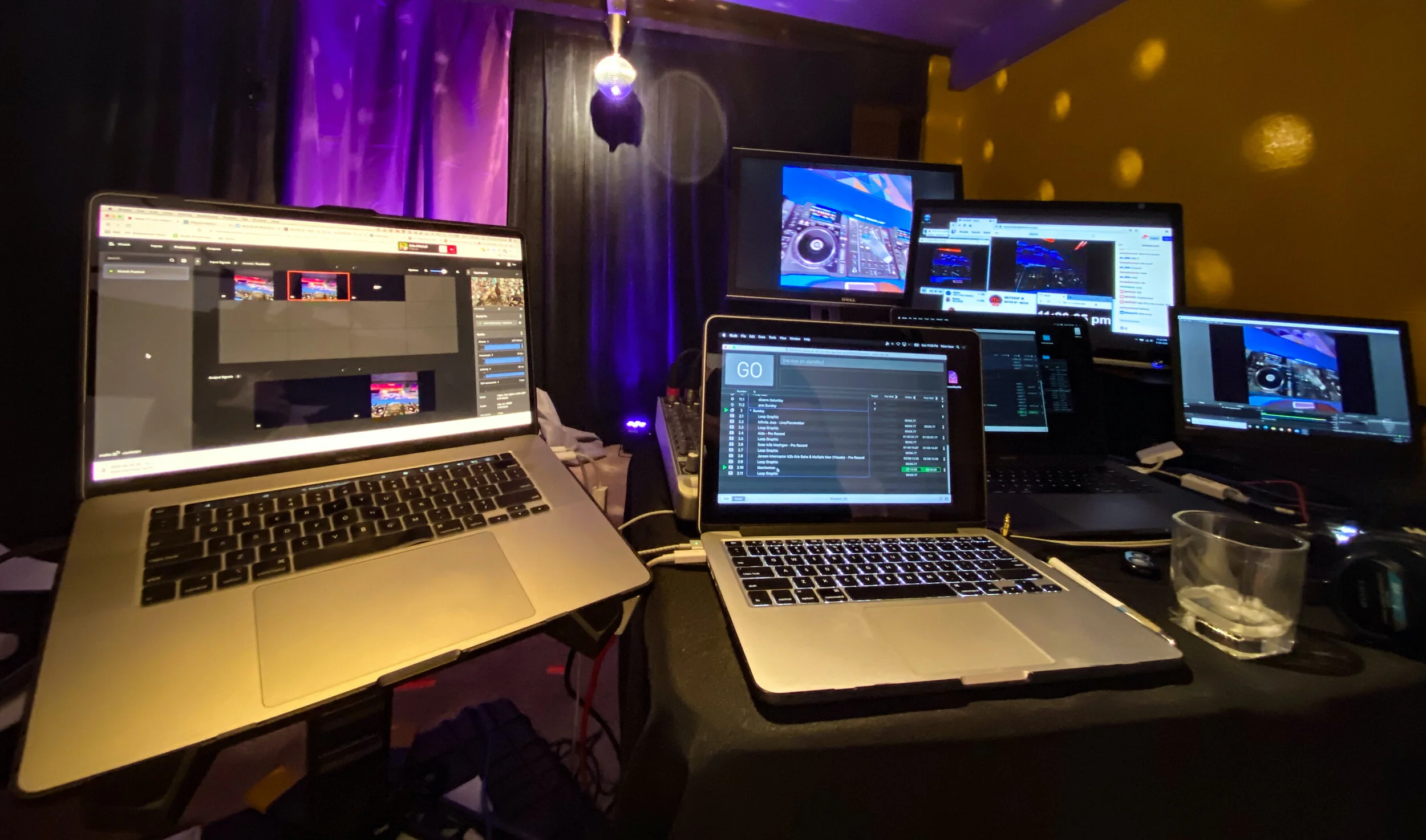
A Music Festival, in this Pandemic?! How Mutek.SF shook up the virtual event scene
Mutek is an internationally renowned electronic music and digital arts organization that hosts annual festivals in cities globally. The relatively new Mutek San Francisco chapter was faced with a challenge for their 3rd annual festival in May 2020: In the face of Covid-19 should they cancel, or find a way to translate an engaging, creative community festival to a virtual event.
Mutek San Francisco hosted Nexus, their 2020 online music festival, using a bespoke virtual community event platform custom built by Currents.fm for the event. Nexus combined live video streams, video-on-demand, a gallery of online Open GL artwork, live workshops on a variety of creative topics, and community-submitted art, music, and live video streams from the SF Bay Area and all over the world.

Conceptual Signal Flow Drawing for Mutek Nexus 2020
Mutek is an internationally renowned electronic music and digital arts organization that hosts annual festivals in cities globally. The relatively new Mutek San Francisco chapter was faced with a challenge for their 3rd annual festival in May 2020: In the face of Covid-19 should they cancel, or find a way to translate an engaging, creative community festival to a virtual event?
Mutek San Francisco hosted Nexus, their 2020 online music festival, using a bespoke virtual community event platform custom built by Currents.fm for the event. Nexus combined live video streams, video-on-demand, a gallery of online Open GL artwork, live workshops on a variety of creative topics, and community-submitted art, music, and live video streams from the SF Bay Area and all over the world.
Making the event community-focused and highlighting community contributions was key to the experience. In addition to the curated musical performances, live DJ sets, and film screenings, the festival highlighted live trainings and performances from both Bay-Area and global artists, as well as links to other concurrent festivals. The live audience interacted with each other and the artists via text and video chat built into the interface alongside the artwork and performances.

The Currents.FM Live Event Interface
In addition to the task of building a custom audience-facing platform, this event posed multiple content-delivery challenges. With multiple live “rooms” running simultaneously with a mix of live and pre-recorded content from many different locations, there were many sources of content going to several different destinations. There were questions of streaming infrastructure, of video endpoints at both the artist (contributor) and audience delivery endpoints of the signal flow, as well as questions of routing in between. This project required both technology solutions and the team to develop and implement them.
Mutek SF Technical Director John Mitchell brought in streaming engineers Drew Patterson of Fresh AV and myself, Tim Kerbavaz of Talon AV to provide live streaming and virtual event management expertise. Drew provided early-process technical management, and Jessie McDaniel, also of Fresh AV, provided show-day artist and stage management, coordinating live remote performances and asset collection.
As a team, we implemented a mix of technologies to make 4 concurrent live rooms possible. Two of the rooms were a mix of live content from artists’ homes and playout of pre recorded performances submitted in advance. Another room was a film screening room playing a timed schedule of films, and the fourth was a workshop room with live presentations by contributing artists.
Leveraging our live event and online video expertise, Drew and I spun up playback systems in redundant locations, with playback locations in both Texas and California, as well as cloud-based playback and routing.
We used LTN Live Video Cloud, which is a cloud-based video routing system to manage, route, and record live contributions. For timed playback of pre-recorded content, we used LTN/Make.TV Playout, a cloud-based broadcast playout application, and Figure53 QLab, a desktop cue-based playback system for Mac OS. Endpoint destination streams went to Vimeo Live, Twitch, Facebook, and Youtube.

Author Tim Kerbavaz in the Sacramento Control Room for the Mutek Nexus Festival
These infrastructure choices proved to be essential to the success of the event. QLab’s Wall-Clock triggers and time-based loop cues in LTN Playout made scheduling playback based on time of day an easy feat, and the cloud routing and playback solutions from LTN enabled remote performers from all over the world to each have their own RTMP or WebRTC ingest credentials and for a team of technicians and production staff spread across two states and 3 metro areas to collaboratively manage the same production.
This was a great opportunity to try some new tools and be a part of a one-of-a-kind live music experience. The event pushed the envelope of online events, creating a new model of what a virtual event can look like and letting us stretch to the cutting edge of both video streaming and event platform technology. I look forward to applying these skills and technologies to future projects.
Tim Kerbavaz is the Technical Director of Talon Entertainment Audio Visual.
Talon Entertainment Audio Visual provides event AV production services for private, corporate, and community events across the United States. Serving a wide range of events, from political round-tables, to Silicon Valley Tech Company Conferences, to community festivals, to automotive-industry board meetings, Talon AV provides expertise and an exemplary attendee experience.
Not Quite Live Stream: A Virtual Event Video Playback Solution
I got a call this week from a client asking “how do we do an event that looks like a live stream, but is actually pre-recorded?”
Lots of the virtual events I’ve been working on have had pre-recorded sessions, if not been fully pre recorded, so I thought I’d share how I’ve been handling playback for Zoom calls or Live Streams.

Signal Flow Diagram of a typical virtual event playback solution
I got a call this week from a client asking “How do we do an event that looks like a live stream, but is actually pre-recorded?”
Lots of the virtual events I’ve been working on have had pre-recorded sessions, if not been fully pre recorded, so I thought I’d share how I’ve been handling playback for Zoom calls or Live Streams. For my higher profile events I use an ATEM Mini as an A/B switch for my redundant playback machines as well as for USB capture, but you could easily use a single playback machine and a capture card like a Magewell, a U-Tap or an UltraStudio to ingest the HDMI input into your streaming computer, and/or go directly into an encoder like a Teradek Cube to go live to stream.
Using Figure53 qLab for playback, I set “wall clock” triggers to play certain files at certain times based on the time-of-day, and then once it’s set, it’s easy to manage multiple breakout rooms at once with minimal manual input.
Reach out if you need help putting together a live event broadcast system (or if you’d like Talon to turnkey your production). Happy to provide a consult, additional assistance, or a full-service production.
Tim Kerbavaz is the Technical Director of Talon Entertainment Audio Visual.
Talon Entertainment Audio Visual provides event AV production services for private, corporate, and community events across the United States. Serving a wide range of events, from political round-tables, to Silicon Valley Tech Company Conferences, to community festivals, to automotive-industry board meetings, Talon AV provides expertise and an exemplary attendee experience.
Presenting the Class of 2020 (Virtually)
I got a phone call in March from a long-time-client - can you make our graduation virtual?
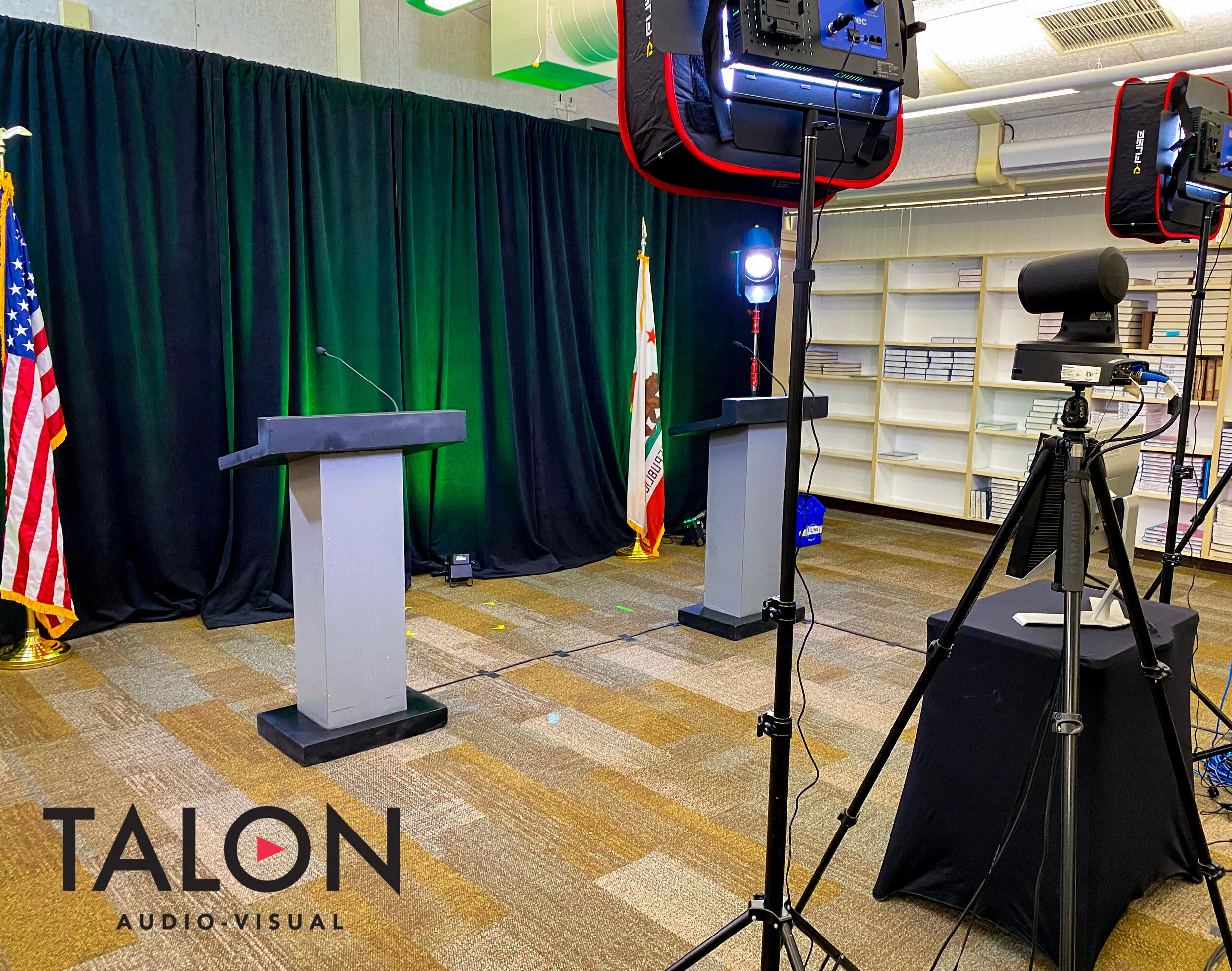
When Da Vinci approached me to reimagine their graduation as an online event, I knew their event needed more than a pre-recorded video or a teleconference link. Working with school administrators and district officials, we got permission to build a studio in a classroom and broadcast their event live from the high school campus. Over June 10th and 11th, we transformed the media classroom into a studio with pipe and drape, lighting, a few lecterns, two vans full of video equipment, and 4 technicians: Technical Director, Graphics Operator, Robo Camera Operator, and Producer/Show Caller, all all positioned to preserve safe social distancing.
I got a phone call in March from a long-time-client - can you make our graduation virtual?
Talon has been producing the live, in-person graduations for Da Vinci Charter Academy for a number of years, and they, like schools all over the world, were struggling to conceive of what a virtual graduation would look like. Da Vinci is a small charter school that emphasizes values of inclusivity, diversity, and student-driven collaboration. Their graduation ceremony features student MCs, awards, and each student’s “15 seconds of fame” - a 15 second video made by the graduate about their time at the high school, followed by live remarks about each student by a teacher whose classes they took.
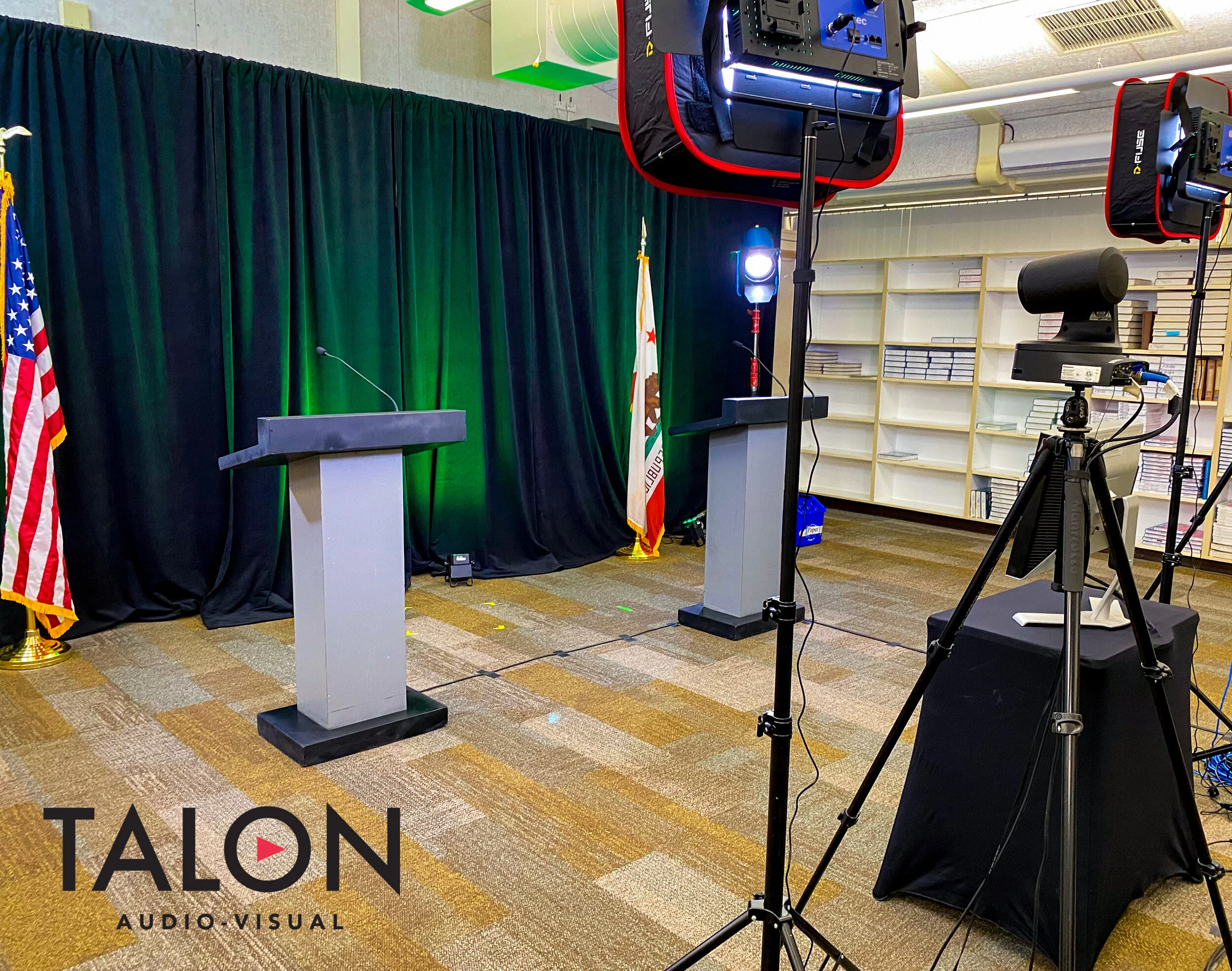
The set, with Pipe & Drape Backdrop, Socially Distant Lecterns, robo cams, and lights visible.
When Da Vinci approached me to reimagine their graduation as an online event, I knew their event needed more than a pre-recorded video or a teleconference link. Working with school administrators and district officials, we got permission to build a studio in a classroom and broadcast their event live from the high school campus. Over June 10th and 11th, we transformed the media classroom into a studio with pipe and drape, lighting, a few lecterns, two vans full of video equipment, and 4 technicians: Technical Director, Graphics Operator, Robo Camera Operator, and Producer/Show Caller, all all positioned to preserve safe social distancing.
The resulting production was a live multi-camera broadcast with both student-produced and Talon-created assets. The show opened with a live to camera gag between the principal and vice principal at socially-distant (6’ apart) lecterns, followed by a student-produced video featuring the Student MCs, a capstone video, and childhood photos of the graduates. Talon provided formatting guidance and stock music sourcing, but it was student-created from start to finish. The goal of this segment was to feature the work, talents, and creativity of the graduating class and to allow the student team to honor their classmates. The student video then led into Talon-produced live segments including an awards ceremony, and the giving of diplomas, which honored each student by showing their 15 seconds of fame video and then displaying their name and graduation photo in a Picture-In-Picture format while a teacher spoke about their time at the school.
To produce the graduate graphics, speaker lower thirds, and award graphics, the Talon graphics team used an automatic form-fill process that linked a folder of images provided by the school administration with a spreadsheet of student names, awards, and speaker titles. This allowed for last-minute changes, and made onsite script changes easy to accommodate.
We used school-provided internet access, getting approval and dedicated network connectivity for our equipment and permission to bypass school network restrictions and firewalls. We also provided a cellular network backup, so that we could keep streaming even if the network were to fail.

Monitoring the livestream while calling cues, with video village and the set visible beyond the computer monitor.
Live chat, moderated by the technology teacher at the school, provided a way for students and families to interact in real time, and cheer each other on.
Post-event, the video was made available to parents to watch online and to download as a keepsake.
The event went very smoothly, and we were able to accommodate onsite and mid-show changes easily. We had some last-minute content changes during rehearsal that were easily accommodated by the graphics workflow. The biggest lessons learned for me were twofold - allowing ample pre production time and a full day of setup allowed us to adequately prepare equipment and content, and using a flexible, adaptable graphics workflow allowed us to make onsite changes to graphics, graduate photos, and lower thirds without the need to re-render or individually edit assets.
It was an honor to help DaVinci Charter Academy conceive and execute a socially distant program to honor the hard work and dedication of their students and families. With a great team and flexible systems we were able to roll with last-minute and during-show changes, broadcast live to a remote audience, and provide families with a memento when they couldn’t come to an in-person celebration. Special thanks to our friends at Argus HD who provided equipment and staffing support and to DaVinci Charter Academy and the Davis Joint Unified School District for trusting us to produce their event.
Recording of Da Vinci High Graduation 2020

Author Tim Kerbavaz, in mask, pausing for a selfie between cues while producing the graduation.
Tim Kerbavaz is the Technical Director of Talon Entertainment Audio Visual.
Talon Entertainment Audio Visual provides event AV production services for private, corporate, and community events across the United States. Serving a wide range of events, from political round-tables, to Silicon Valley Tech Company Conferences, to community festivals, to automotive-industry board meetings, Talon AV provides expertise and an exemplary attendee experience.

24 Months and Beyond: The Event Industry in a Post-Social Distancing World
Many of us have written about what the next 12-18 months look like for the events AV industry, but I haven’t read much about what our industry will look like after the events industry bounces back. What happens in the next 24 months, and beyond?
Here are some of my thoughts.
Many of us (myself included, twice) have written about what the next 12-18 months look like for the events industry. It’s going to be rough, there will be a lot of video conferences, and we’ll figure out what “virtual event” really means. I think we’ll see some interesting innovation, and some people and companies will be able to make a decent, if less than typical, living. Others won’t be so lucky, and I expect some production companies won’t be in a good position, and some technicians will leave the industry. I am confident, however, that our industry will come out of this and thrive. I’ve read lots of thoughts about the short term, but I haven’t read much about what our industry will look like after the events industry bounces back. What happens in the next 24 months, and beyond?
Whenever live events come back, I expect our whole world will look a little different, and that the AV and Events industries will reflect that.
Counting on video conferencing
At the lower end of the market, Zoom, Webex, and other desktop Video Conferencing platforms are commoditizing and democratizing VC. With the news that Verizon is buying BlueJeans, we can expect more and more consumer and self-service commercial VC to be the norm. Our clients and audiences have embraced desktop VC, often entirely without AV professionals.
One rental and staging executive I talked to was worried about how to keep providing value at the lower end of the market when there are so many DIY technologies. I too often worry what value I provide when supporting Zoom or other VC calls - what is the value proposition when the end users can do it themselves. “It’s so easy” I say to myself. To this point a friend reminded me that of course it’s easy for us, this is our livelihood, but for our customers it’s a business need and worth hiring help to remove pain points. My friend offered the analogy “think about how your accountant feels doing your taxes” - it’s old hat for them, but I gladly pay for the service. While the technology is more and more consumer friendly, I think we can continue to provide value in white glove VC and remote event services, in both the short- and long-term.
The small stuff will come back first
Even before conventions and sports games and concerts can happen, I expect to see smaller events happening in smaller venues, bars, and restaurants. Audiences are starved for socializing, so I expect that companies will have small meetings, small bars will have live music, and hotels will see bookings trickle in. Humans are social creatures, and I suspect we’ll gather in small groups as soon as it’s allowed and reasonably safe to leave the house. These events will have strict in-person attendance caps, and many attendees still won’t be comfortable going out. While they won’t necessarily have much production budget, many of these smaller events will have a live-streamed or video conference component. Once the service sector returns to operation, we’ll start to see bookings for these small gigs, and a niche market for value-engineered turnkey small event VC and streaming packages.
Once a vaccine is available and wider restrictions are lifted and, we will see the return of larger events. At this higher end of the market, I expect to see changes in the way events operate, and perhaps even growth in some areas.
An evolving office means evolving events
As companies have transitioned employees to remote work for the duration of this quarantine, I have heard from business executives, tech support staff, and space planning teams that many companies, across industries, are reconsidering their office layout. The open office may no longer be trendy, and frequent or permanent remote work may become the norm at many companies across industries. Businesses that are equipped for a partially or fully remote workforce will be able to get back to work before a vaccine is ready, and will be able to quickly adapt to future challenges because the infrastructure for telework will already be in place.
““I think you could see a doubling down on the (big in-person events) where they create a ‘narnia’ in real life because everyone has been living behind a device””
The big challenge for both management and remote workers is that they see less of their colleagues in person, so connection, shared vision, and team bonding can be a challenge. All-Hands meetings and team retreats will be increasingly important to building cohesive teams and to business success. With limited time for team bonding and internal networking, the ability to gather in one room for a meeting becomes critical.
With fewer desks and less expensive real estate to pay for, operating budgets may have more room for bigger, more elaborate productions, both internally and for client- or public-facing events. An added incentive - with everyone, coworkers and clients included, working from home on a laptop, the chance to go out to an event is a great change of environment. Thus event production, scenic, and lighting can be positioned to provide a welcome sense of escapism from the home office.
“I think you could see a doubling down on the (big in-person events) where they create a ‘narnia’ in real life because everyone has been living behind a device” posited Kyle Santen of PixelForge. “More money will get poured into physical events to make up for the lack of physical connection outside of the events” because everyone has been working remotely from home.

An increased interest in escapism, wow-factor, and atmosphere makes a ripe market for Media Server makers like Disguise, GreenHippo, Watchout, and Resolume. New demands for immersive experiences, polish, and effects could lead to new opportunities for augmented reality, mixed reality, and virtual reality, both in person and online.
Even in-person events are likely to have an increased focus on the online viewer; broadcast will be less of an afterthought and more of an equal (or potentially primary) audience. With larger online audiences, and more demand to stand out with eye- catching video, more of the event may be focused on the camera, which leads to more opportunities for new video technologies, 3D graphics, and mixed reality environments.
It will be a long while before we can gather in person and events can return to some semblance of normal. We’re looking at a timeline of 12-18 months to start moving back to large gatherings, and in the meantime client needs and expectations are changing. When we’re back on production, we should be ready for an evolved events market that includes more online and video-heavy productions, both big and small, and be able to provide an increasingly immersive and exciting in-person experience. We have a lot of down time, so now is a great time to re-imagine our recurring events to make them ready for a Post-COVID world. There are lots of training opportunities, and now would be a great time to share skills you have with your friends and peers in the industry. Even if we won’t see the curtain rise on a big show for a while, we can make sure now that our shows on the 24 month horizon are ready for a revamped production environment.
Tim Kerbavaz is the Technical Director of Talon Entertainment Audio Visual.
Talon Entertainment Audio Visual provides event AV production services for private, corporate, and community events across the United States. Serving a wide range of events, from political round-tables, to Silicon Valley Tech Company Conferences, to community festivals, to automotive-industry board meetings, Talon AV provides expertise and an exemplary attendee experience.
Cover Photo by Oscar Keys on Unsplash | In-Line Photo by Joshua Hanson on Unsplash